 Open Books
A jury finds a $1.72 overcharge
On 15 April 2026, a jury in Manhattan found that Ticketmaster had illegally kept its monopoly over tickets for major concert venues, and that it had overcharged fans a dollar and seventy-two cents a ticket.1
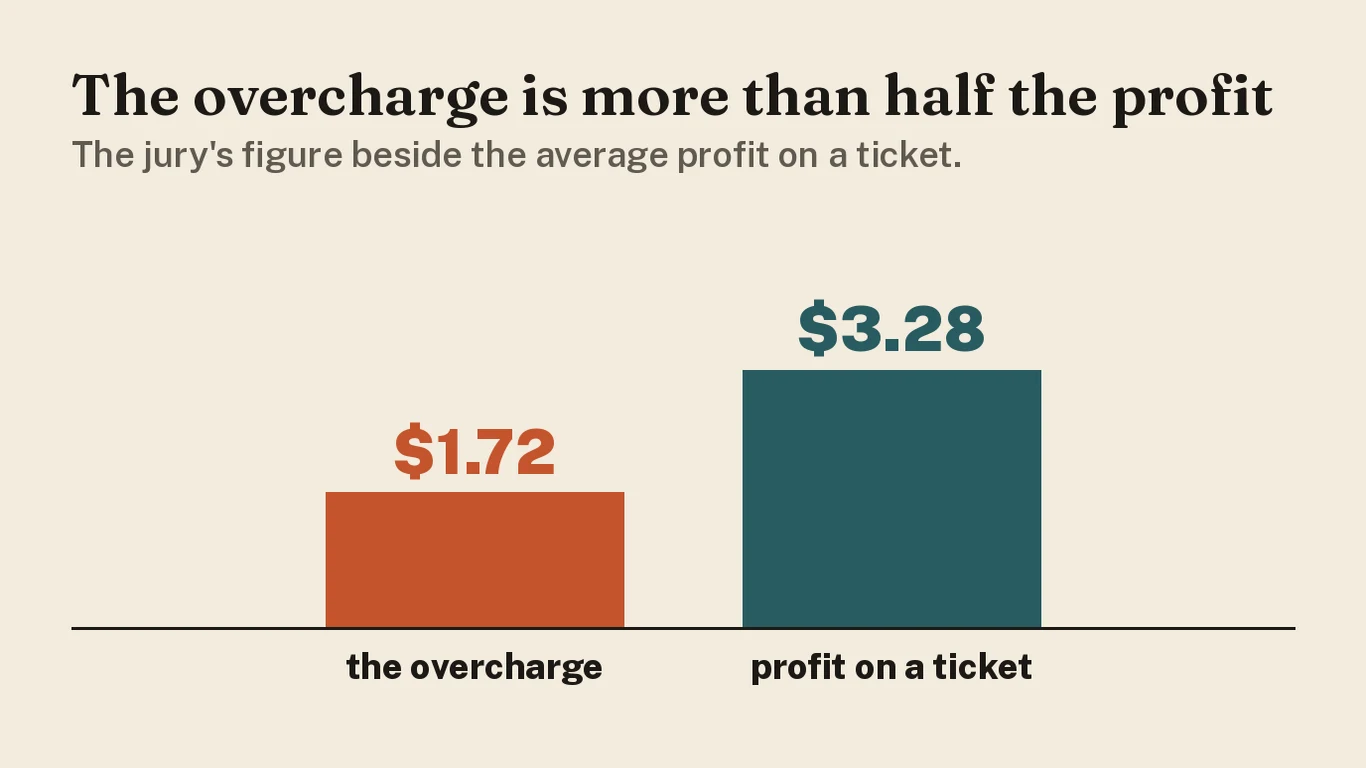
Ticketmaster is owned by the concert promoter Live Nation. Live Nation puts Ticketmaster’s profit in 2025 at about $1.13 billion, on 346 million tickets that carried a fee.2 That is about $3.28 of profit on an average ticket, anywhere in the world. The overcharge the jury found is more than half of it.3
This is how a jury reached that figure, why the government walked out before it did, and why no fan has been paid.
Thirty-three states carry on alone
The winners were 33 states and Washington DC, each suing through its attorney general.4 The Justice Department had brought the case with them in May 2024.5 In the second week of the trial, five weeks before the verdict, it announced a deal with Live Nation and left.6

The deal came suddenly. The government’s own lead trial lawyer told the judge he had first seen it that morning, when the judge did.7 Most of the states refused it, saying it left the monopoly in place, and carried on alone.8 Their new lawyer, Jeffrey Kessler, said he had eight days to prepare.9
Their evidence included a 2022 message between two Live Nation staff about what fans paid at one of its venues. One of them, a regional ticketing director, wrote: “robbing them blind baby. that’s how we do.”10
How a $30 ticket became $42
Three businesses take a share of a concert ticket. The promoter books the artist, guarantees a fee and pays for advertising. If seats do not sell, the promoter loses money; if they sell, it shares the profit with the artist. The venue provides the building and staff, and also earns from extras like parking and VIP packages. The ticket company runs the website, the queue and the barcode at the door. It adds a service fee on top of the printed price and shares that fee with the venue.
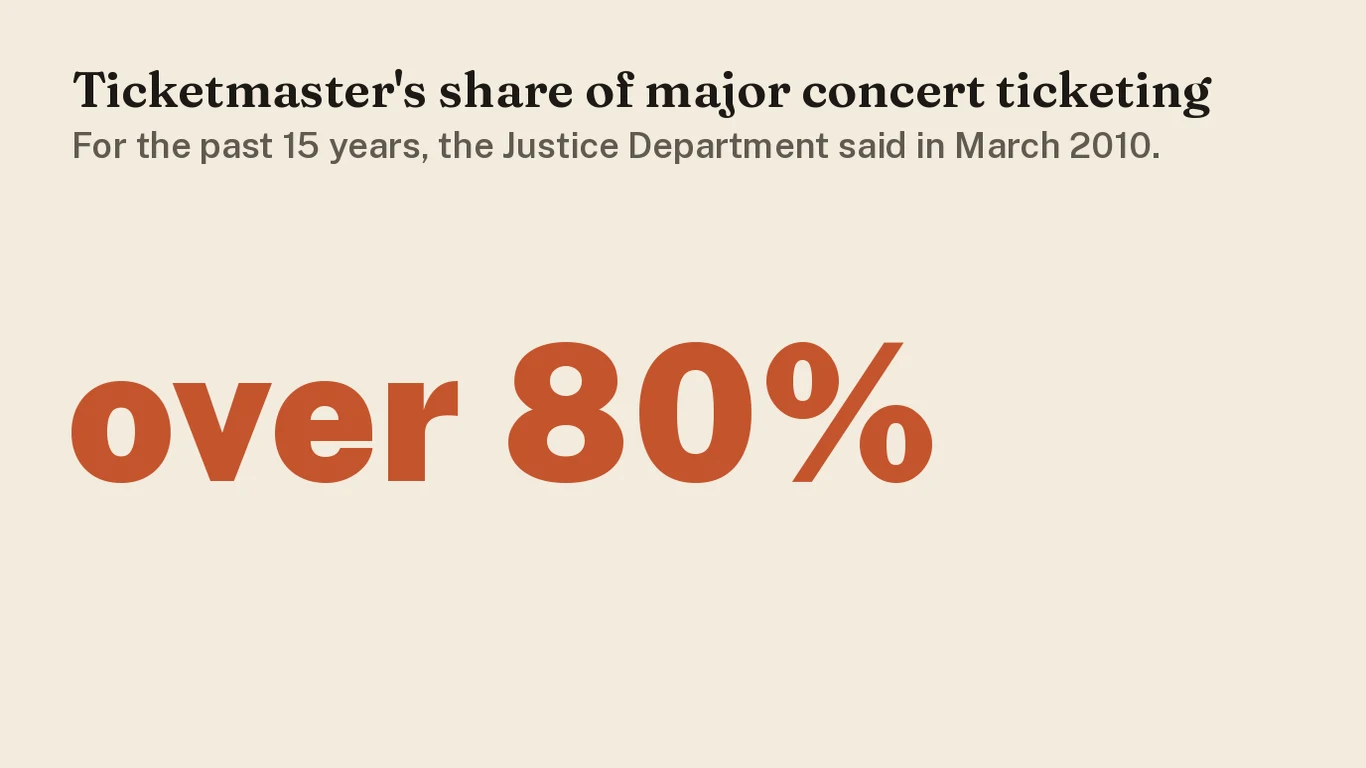
That first sale of each seat is called primary ticketing. The Justice Department says Ticketmaster does it for roughly 80 per cent or more of major concert venues in the United States.11
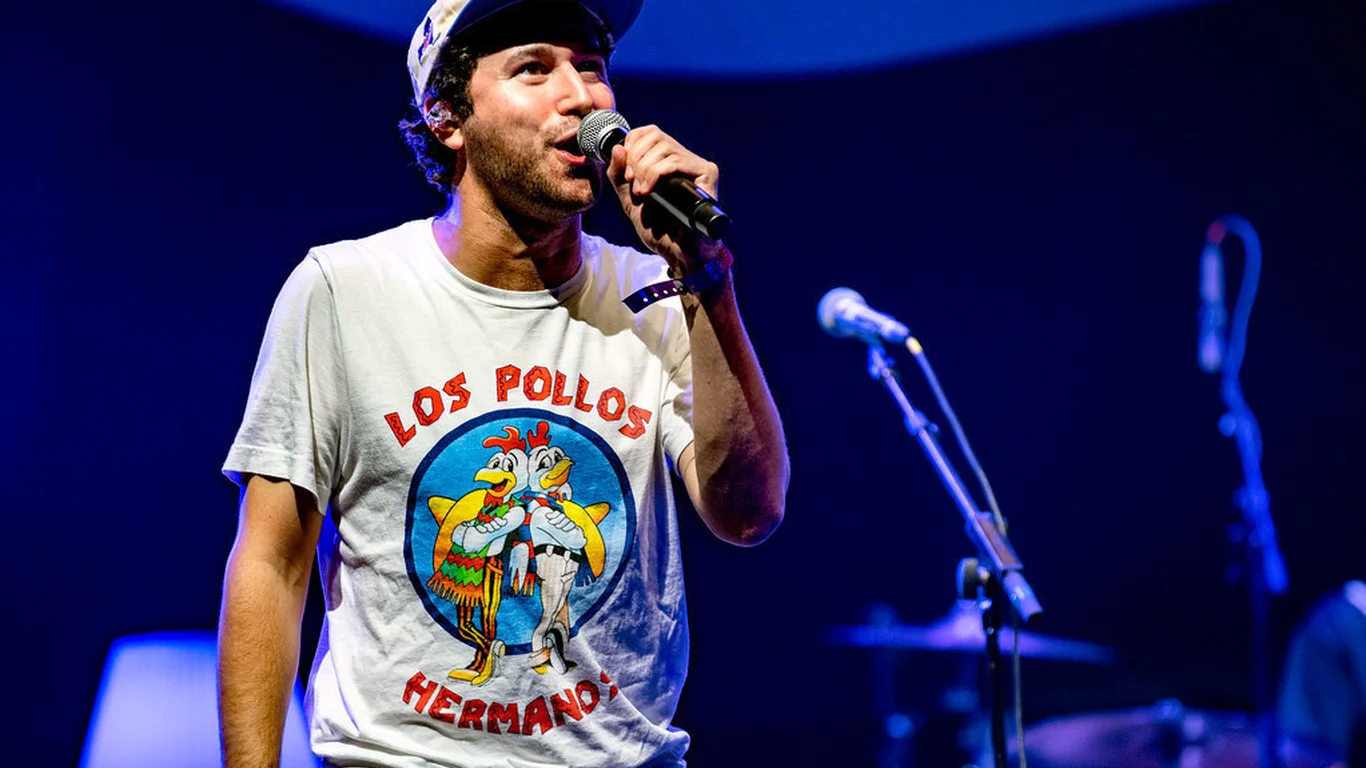
In January 2023 a musician, Clyde Lawrence, gave evidence to the US Senate. He described an imagined sold-out show by his band at a venue Live Nation runs.
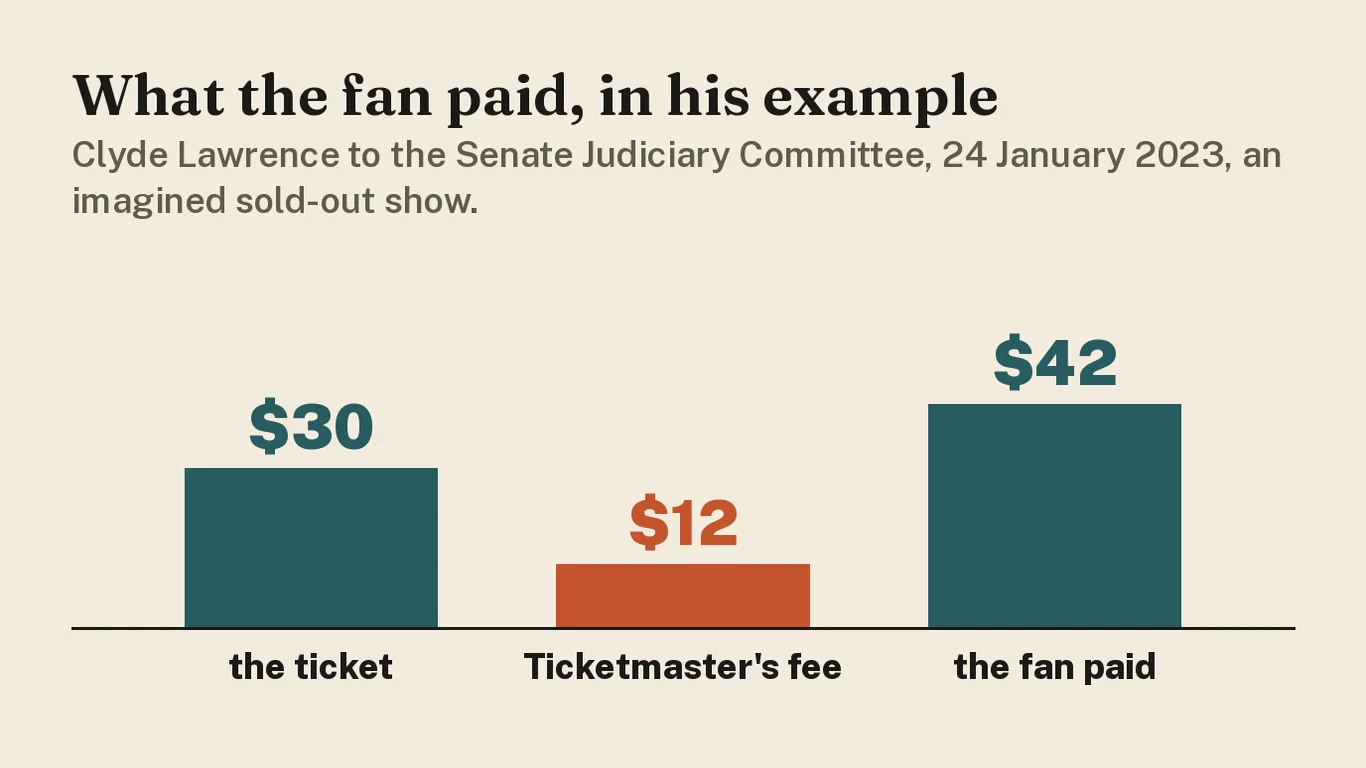
The ticket was listed at $30, Ticketmaster added $12, and the fan paid $42. The show’s costs and Live Nation’s share as promoter came out of the $30. The band got about $12, and none of the fee.12
In his example, one company did all three jobs. Live Nation promoted the show, ran the building and, through Ticketmaster, sold the ticket. It also owns and runs many big outdoor concert venues, called amphitheatres.13
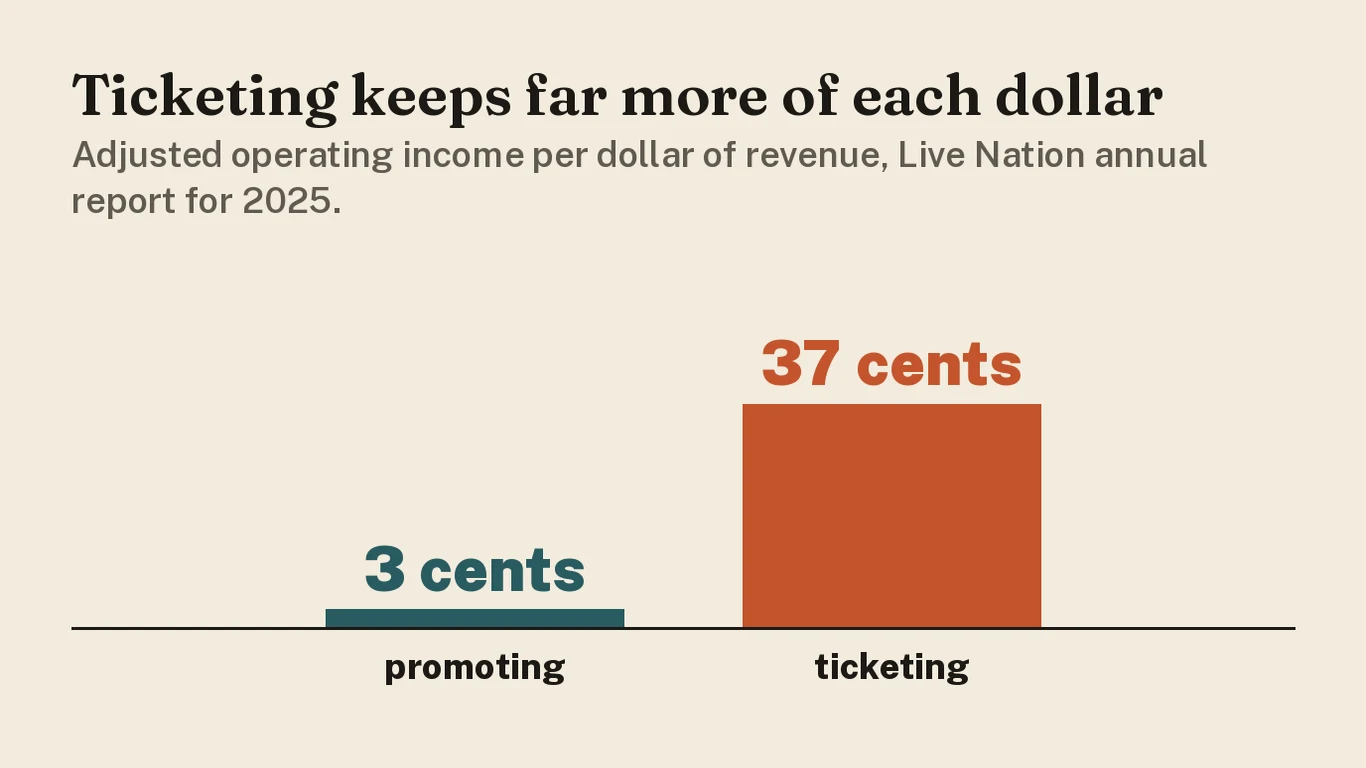
The three jobs earn very different amounts. In 2025, Live Nation kept about three cents of profit from each dollar of promoting income. From each dollar Ticketmaster took selling tickets, it kept about 37 cents.14
What Live Nation promised in 2010
In January 2010, the Justice Department let Live Nation join with Ticketmaster as one company.15 Two months later, at the South by Southwest festival in Austin, the head of the department’s antitrust division, Christine Varney, explained the conditions it had set. She said Ticketmaster “has maintained a market share of over 80% in this market for the past 15 years.”16
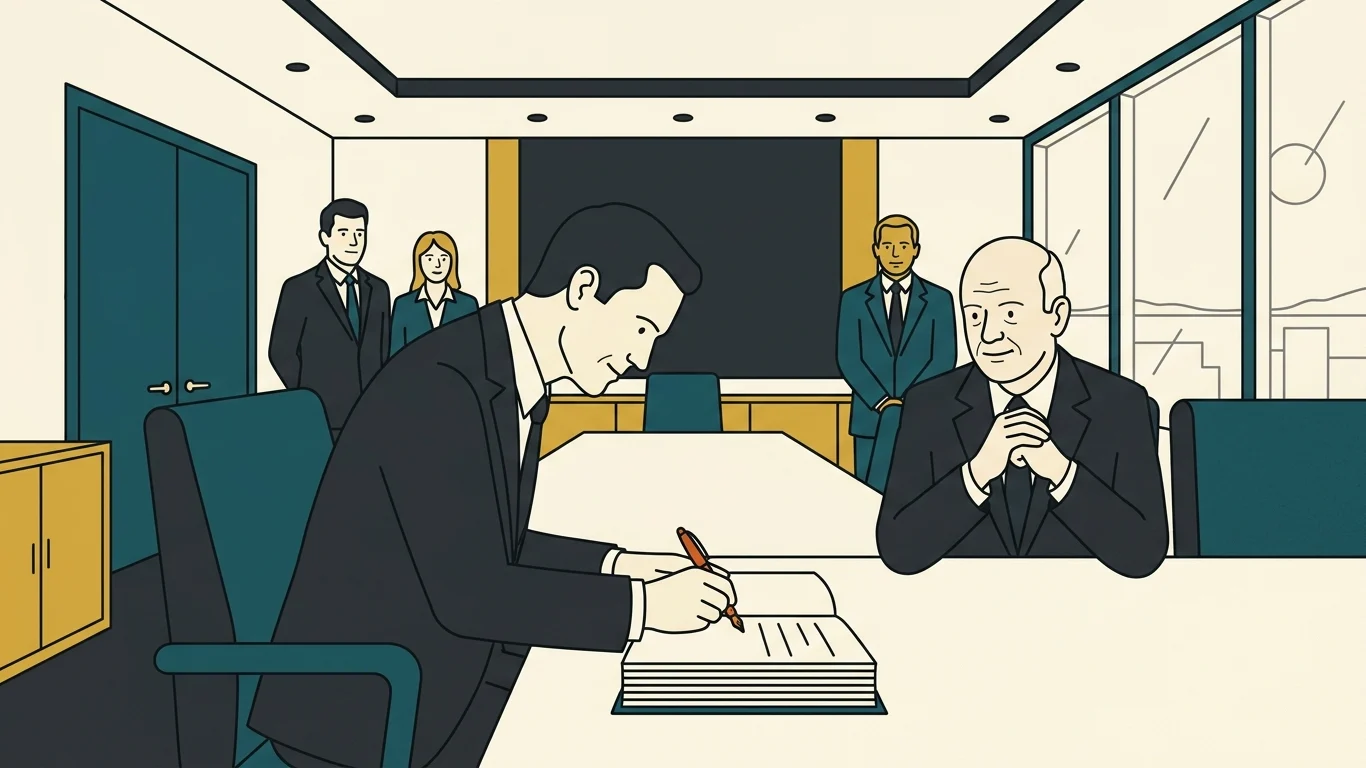
The merger also removed the biggest threat Ticketmaster faced, a ticket service Live Nation had just started. The new company would sell many venues’ tickets and choose which venues its tours played. So a venue that dropped Ticketmaster could lose its concerts.
Varney said that “Ticketmaster and Live Nation will be expressly prohibited from retaliating against any venue that considers or works with another primary ticketing service.” She added: “Live Nation and Ticketmaster will be under the watchful eye of the Justice Department for a decade.”16
In December 2019, nine years in, the Justice Department said Live Nation had broken the conditions. In 2020 the two sides agreed to extend them to the end of 2025.17 They ran out nine weeks before the trial. By the time it opened, nothing was holding Live Nation to those promises.
The Eras Tour crash and the Senate
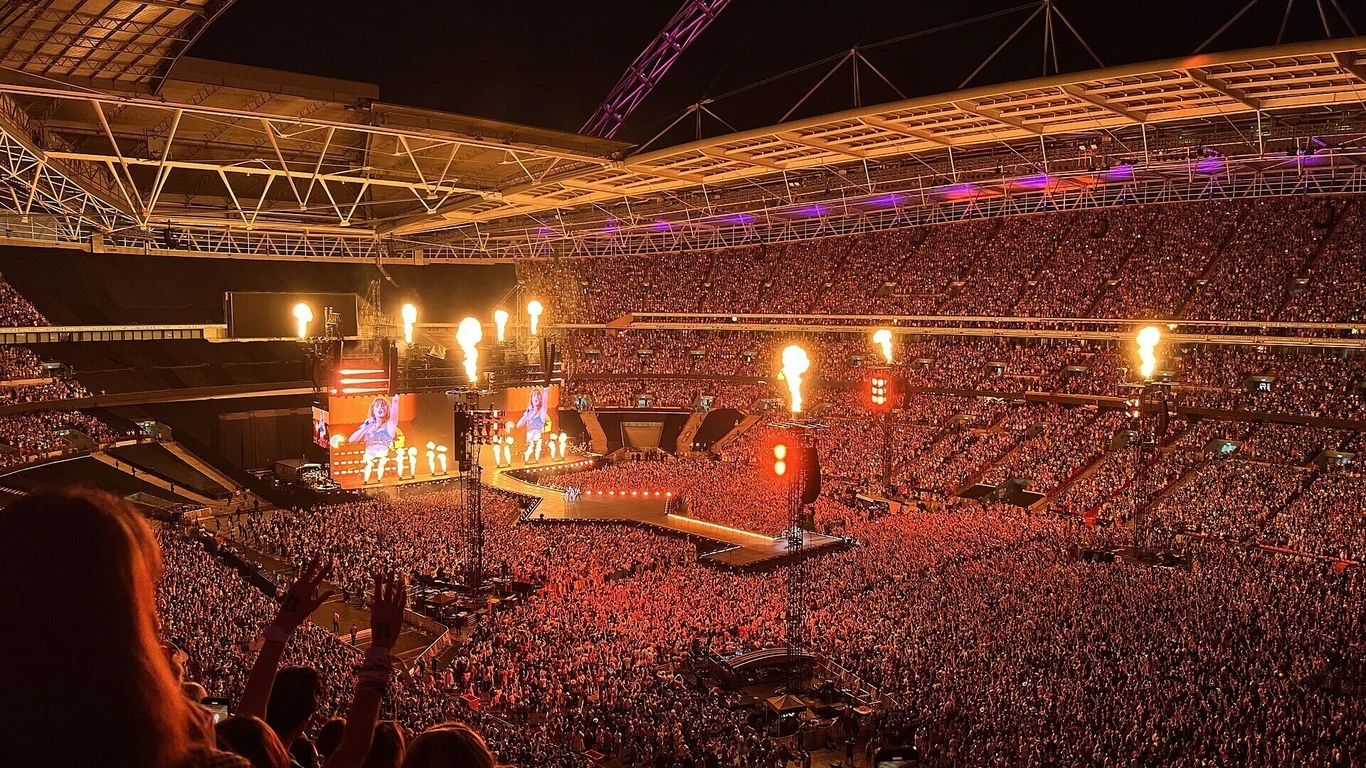
On 15 November 2022, Ticketmaster opened an early sale for Taylor Swift’s Eras Tour. It said it got 3.5 billion requests, four times its previous record, and blamed “the staggering number of bot attacks”, meaning computer programs swamping the sale.18

At a Senate hearing in January 2023, Live Nation’s president, Joe Berchtold, said that “service fees, even if they are called ticketing fees, are retained mainly by the venues.”19 Live Nation’s annual report says the same: the venue sets the fee and keeps most of it, and Ticketmaster takes a cut.20 At many amphitheatres, though, Live Nation is the venue, and there most of the fee stays with Live Nation.
Clyde Lawrence told the same hearing what venues said when asked about fees: “They say not only do we not choose what it is, we do not even know what it is.”19

In May 2024, the Justice Department and a group of states sued to split Live Nation and Ticketmaster apart. The states also sought damages for residents who had been overcharged.5
The arena that left
The trial opened in Manhattan on 2 March 2026, before Judge Arun Subramanian and a jury. In the first week, the jury heard from John Abbamondi, the former boss of Brooklyn’s Barclays Center arena. In 2021 he had moved the arena’s ticketing from Ticketmaster to a rival, SeatGeek.21
He testified that before the move a Live Nation boss texted him to “think about the bigger relationship with Live Nation”, which he read as a “friendly warning to me that I was about to make a big mistake”.21 He said Live Nation’s chief executive, Michael Rapino, told him on a recorded call that it would be “tough to deliver concerts” if the arena went with SeatGeek. Abbamondi called that “a veiled threat, maybe not-so-veiled threat.”22
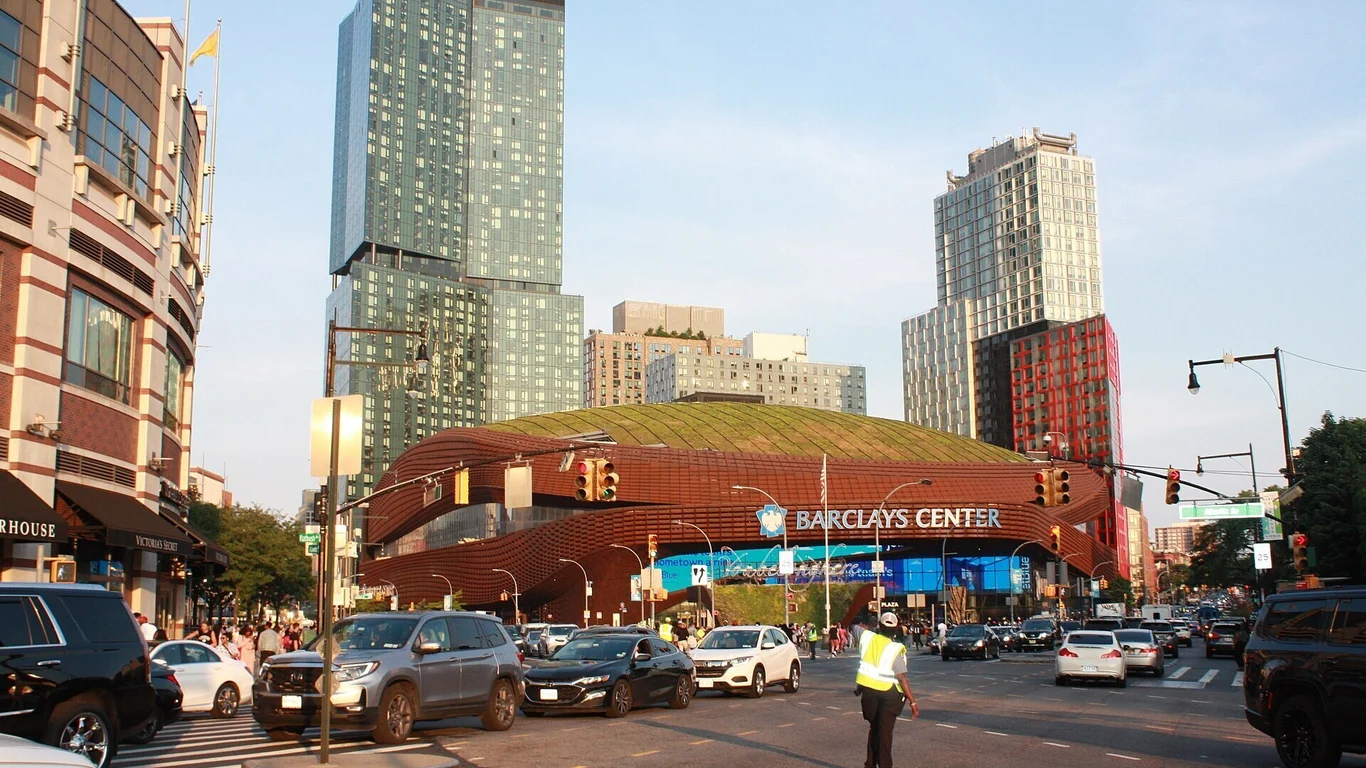

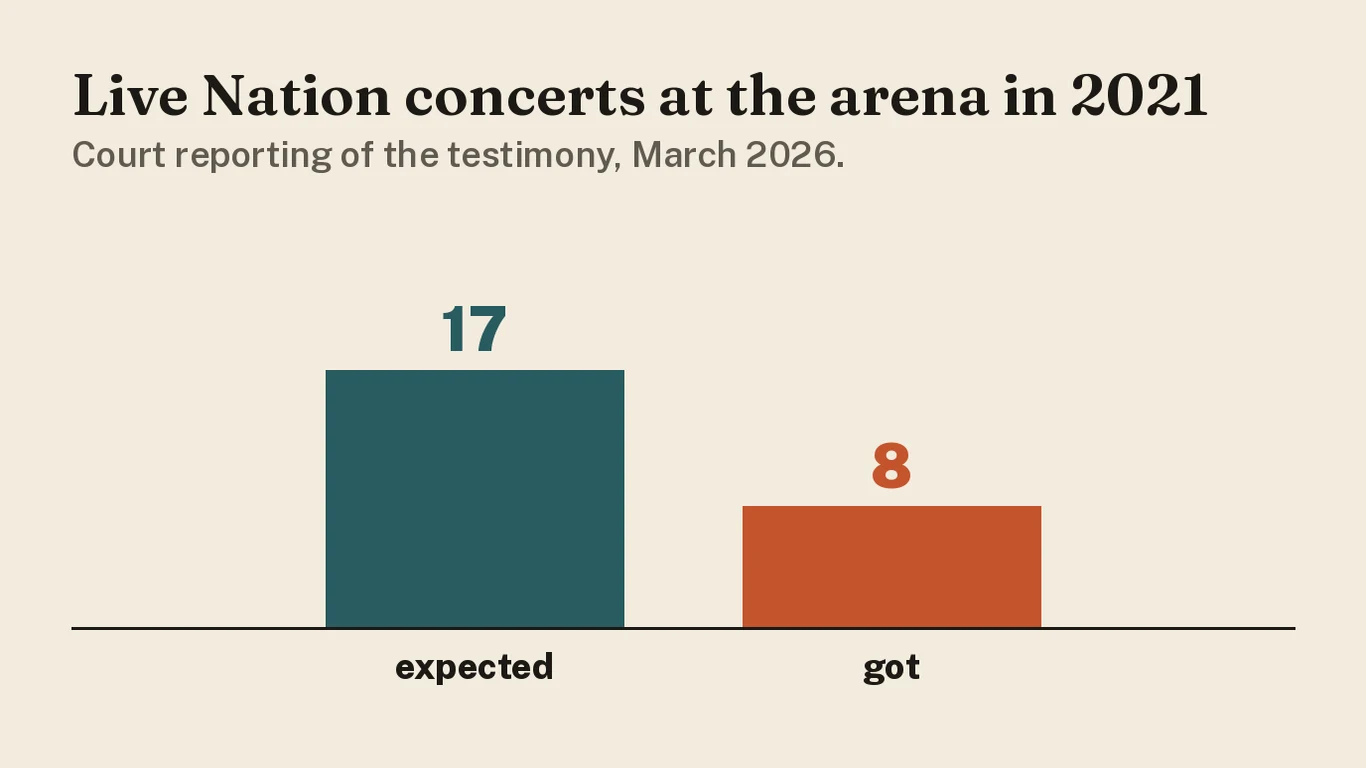
A court reporter wrote that the arena expected 17 Live Nation concerts in 2021, and got eight.23 SeatGeek then offered venues what Bloomberg called “retaliation insurance”: money if Live Nation took concerts away.24 In early 2023, the Barclays Center went back to Ticketmaster.22 Varney’s conditions against punishing venues were still in force when Rapino made that call.
Signed on a Thursday
Gail Slater headed the antitrust division bringing the case. On 12 February 2026, less than three weeks before the trial, she was “ousted from her position”, a group of senators later wrote.25

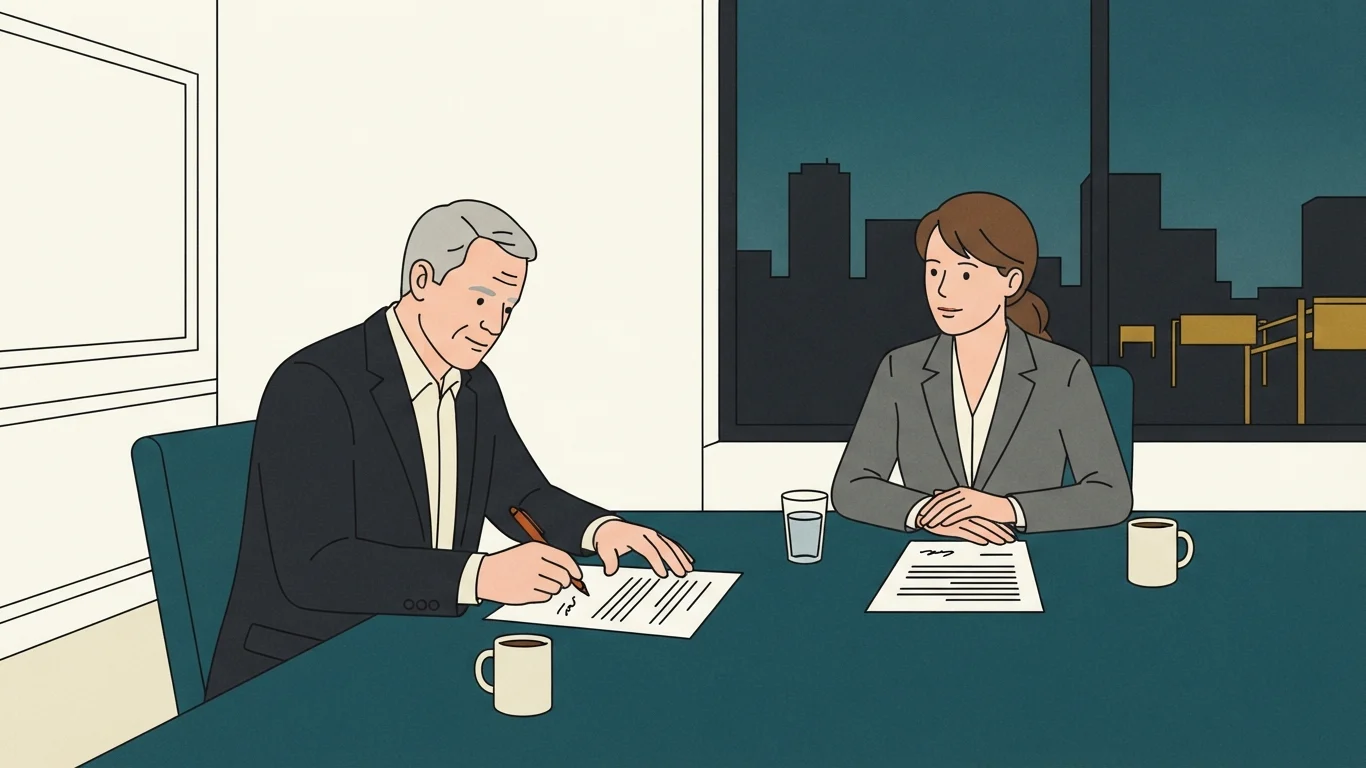
On Thursday 5 March, in the trial’s first week, the government and Live Nation signed a binding outline of a deal, called a term sheet.6 On Monday the 9th, news of it reached the court while a rival promoter’s chairman was giving evidence. Judge Subramanian said: “It shows absolute disrespect for the court, for the jury, for this entire process, and it is entirely unacceptable.”26
The government’s lead trial lawyer, David Dahlquist, told the judge: “I only saw the term sheet when you did, your honor.”7 The senators’ letter said that “Justice Department lawyers trying the case were not involved in the settlement discussions”, and that, according to reports, the terms were worked out at the White House.25 Kessler later said the deal was “directed from elsewhere in the Department of Justice and the administration”.9
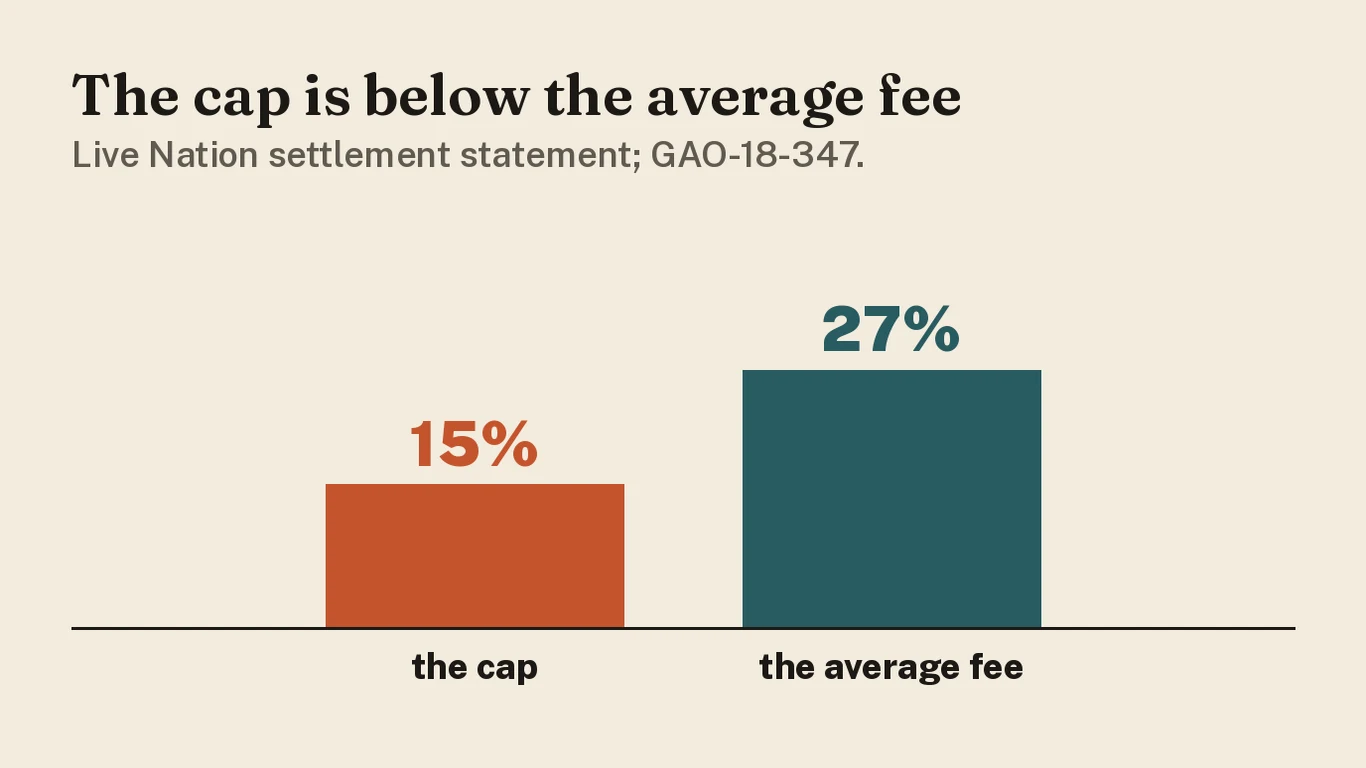
Rapino’s statement said the deal meant “capping ticketing service fees at 15%”.27 That cap covers only Ticketmaster tickets at Live Nation’s large amphitheatres; arena and stadium shows are left out.28 A 2018 study by the US Government Accountability Office found that ticket sellers’ fees averaged 27 per cent of ticket prices.29 The cap is lower than that average, and fans at arena and stadium shows get no cap at all.
Six states signed up to the deal.28 A senior Justice Department official, not named, told reporters it was “a win-win for everybody”.30 New York’s attorney general, Letitia James, said it “fails to address the monopoly at the center of this case.”30 The other states still wanted Ticketmaster split off, and damages for their residents.
The judge sent the jury home for a week and ordered the two sides to bargain. When one lawyer sounded doubtful a deal could be reached, the judge replied, as the trade paper Pollstar reported: “Not with that attitude.”31 The deadline passed with the states still in the case.
Eight days
The jury was due back on Monday 16 March. The states had relied on the government’s trial team, and had no lead trial lawyer of their own.9 Led by New York, they hired Jeffrey Kessler, an antitrust lawyer who had beaten the NFL in court over players’ freedom to change teams, and had fought the league’s ban on the quarterback Tom Brady.32
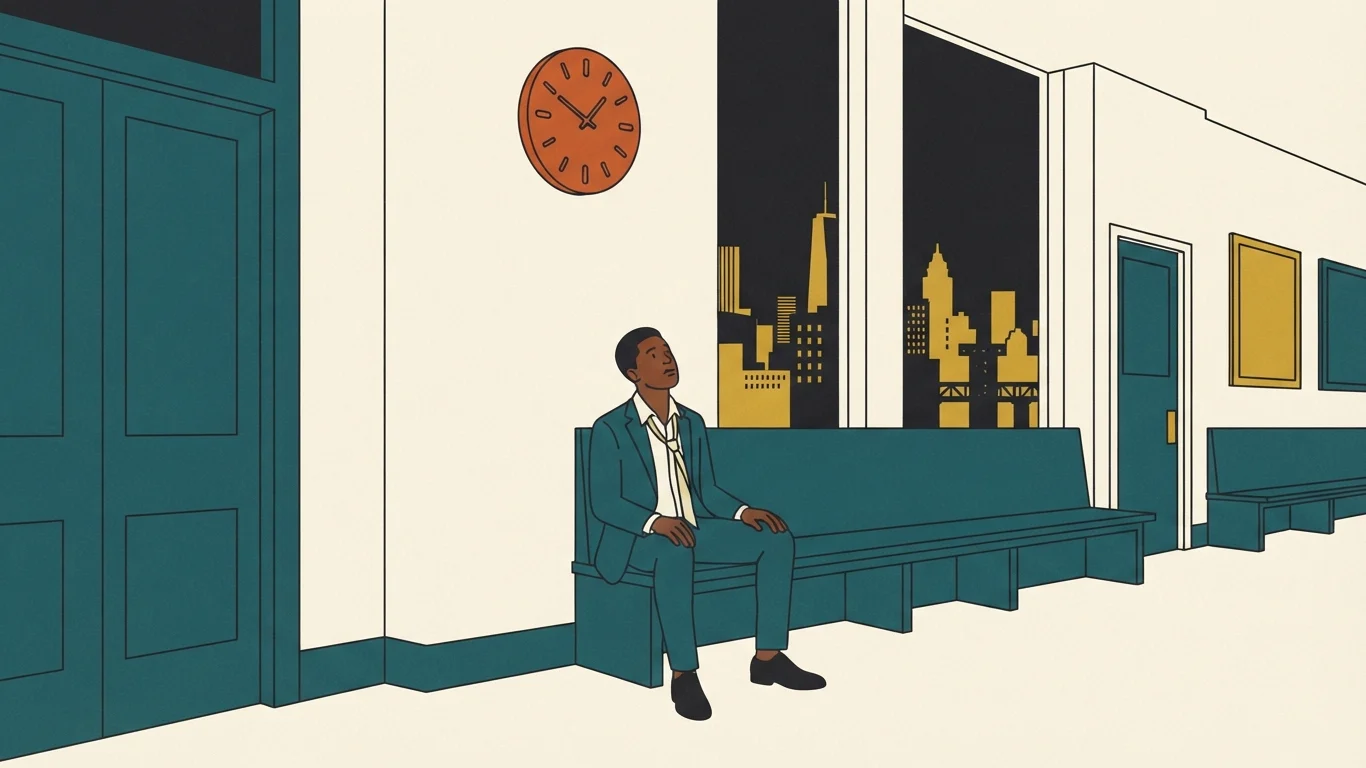
Kessler told Rolling Stone: “I hoped that we would get at least two weeks, if not longer … We ended up with eight days!” He added: “I don’t think there’s another case in the history of antitrust where a week in, a new lead trial counsel was asked to come in.”9
He found the 2022 Slack messages and told his deputy: “Oh my, God, did you read these Slack messages?”9 The day after the trial began again, the states’ first witness was their author, Ben Baker. Kessler said he called him early to show the jury Baker was no low-level employee.9
Robbing them blind
In early 2022, Baker had been messaging a colleague, Jeff Weinhold, about the MidFlorida Credit Union Amphitheatre, a big outdoor venue near Tampa, Florida. Baker wrote: “i charge $50 to park in the grass lmao.” He went on: “i gouge them on ancil prices to make up for it”, meaning ancillary prices, the extras sold at the venue.10
Looking at VIP prices, he wrote: “These people are so stupid.” And: “I almost feel bad taking advantage of them.”33 Live Nation called the messages an exchange from “one junior staffer to a friend”. The Tampa paper Creative Loafing reported his job in 2022 as regional ticketing director.10
In court, Kessler read the message back to him: he had really been “robbing them blind baby. That’s how we do”.34 Baker told the jury: “I used very immature and regrettable language”, and “They were not required to purchase any of these products.”35 He had since been promoted twice and now ran ticketing for Live Nation’s amphitheatres. Asked if he had been demoted or lost pay, he said: “No, sir, not at this time.”36
On Thursday 19 March, Rapino gave evidence. On Baker’s messages he said: “It’s disgusting and it’s not the way we operate.” Asked if Ticketmaster’s fees were outrageous, he said: “No.”37 On threats to venues: “In 15 years, there have been a few of those wild emails.”38 The states read out what he had said under oath in 2019: “Live Nation is a business model that has an incredible moat around the castle.”37
Kessler said he had not needed a dramatic clash with Rapino: “I was perfectly happy with what happened, because what we got were all of these admissions”.9
How the jury got to $1.72
On 25 March, the states’ economist, Rosa Abrantes-Metz, gave her estimate of the overcharge. She used a smaller ticket company, AXS, to show what ticketing costs with real competition, and compared contracts from 2018 to 2024. She told the jury Ticketmaster charged venues about $2.30 a ticket more than AXS did.39
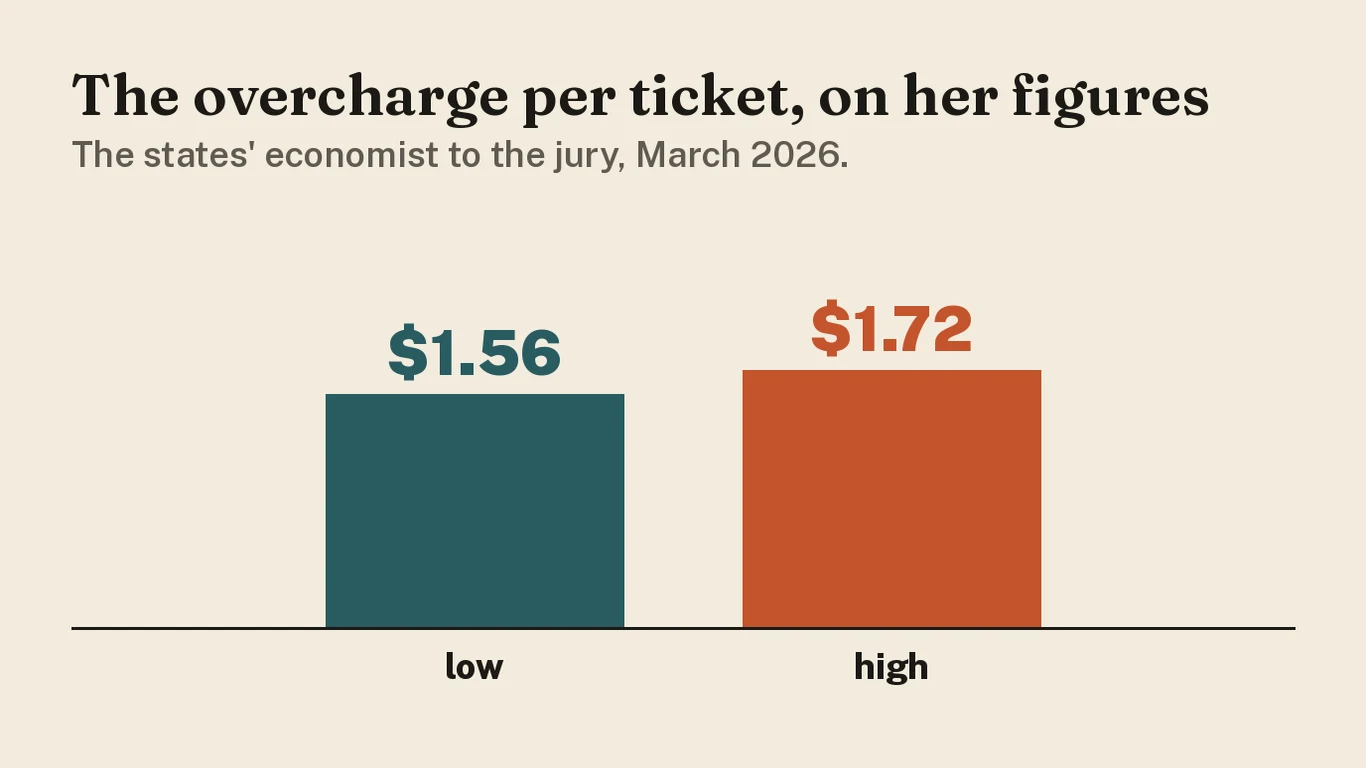
The venue sets the fee that fans pay, so when Ticketmaster charges a venue more, the venue can raise that fee to cover it. She said venues passed 68 to 75 per cent of the extra on to fans. On her figures, the overcharge was between $1.56 and $1.72 a ticket.39 Fans would still pay some fee with real competition, as they do with AXS; her overcharge is only the extra above that.
Live Nation’s lawyers said AXS was a poor comparison, because AXS’s own bosses had admitted its service was weaker until after the pandemic. Part of the gap, they argued, paid for better service. She replied that the overcharges “increased year-by-year”, so the gaps were smallest in the early years, when AXS was weaker, and those years only pulled her figure down.39
In final speeches on 9 April, Kessler called Live Nation a “monopolistic bully”, “digging the moat around the monopoly castle in order to protect their market position.”40 The states said the moat had three parts: contracts giving Ticketmaster sole rights to a venue’s tickets for years; the threat that a venue that left would lose Live Nation’s concerts; and artists who wanted Live Nation’s big amphitheatres having to take Live Nation as promoter.
Live Nation’s lawyer, David Marriott, said it had simply beaten its rivals: “Success is not against the antitrust laws in the United States.” He called Baker’s messages “distractions”.41 American law lets a company become a monopoly by being better. It forbids staying one by shutting rivals out. The jury had to decide which Live Nation had done.
The verdict
The jury talked for four days. On Wednesday 15 April, it found for the states on every claim, including that Ticketmaster had broken the law to keep its monopoly.1
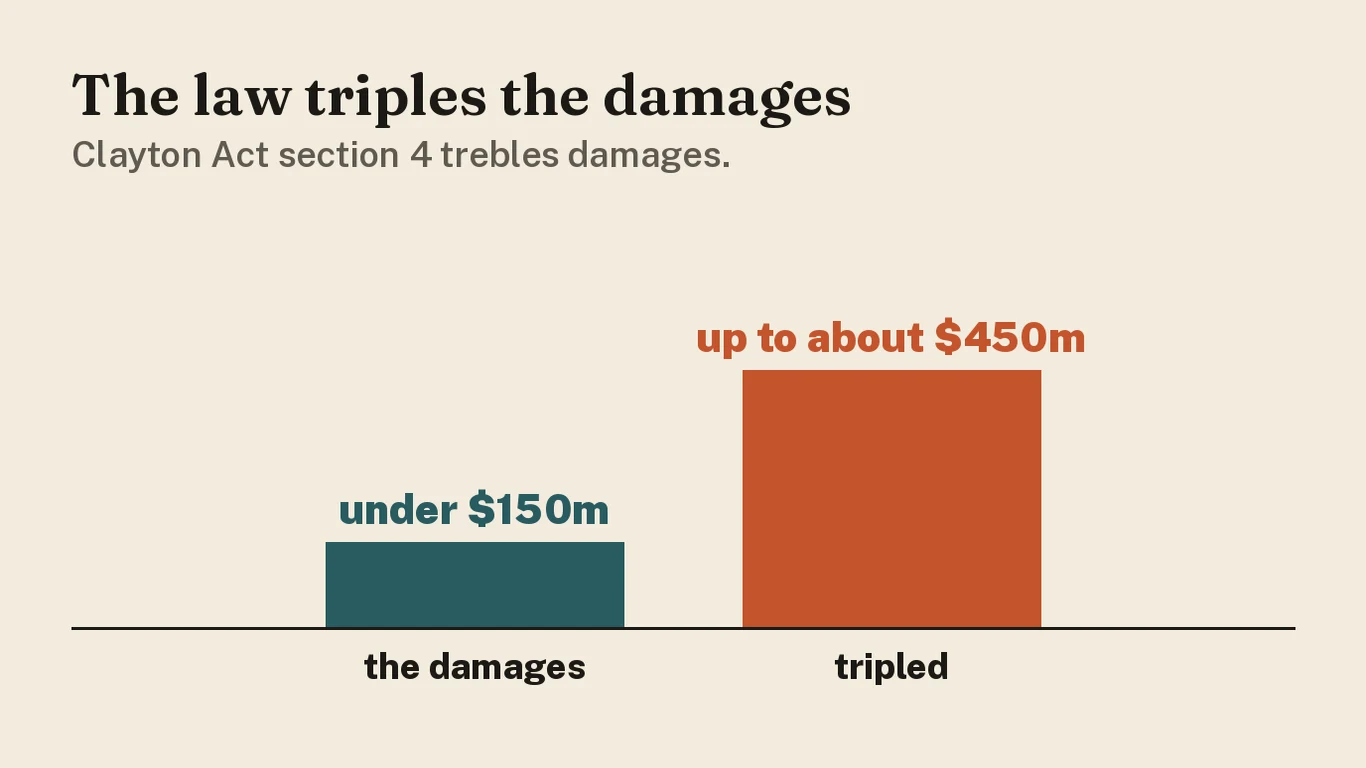
Twenty-two states had asked for damages for their residents. For each, the jury wrote down $1.72 a ticket, covering 257 venues over about five years.42 Live Nation put the total under $150 million.43 The law triples damages in such cases, so the tripled total could be up to about $450 million.44 Live Nation’s net profit in 2025, for the whole company after all its costs, was about $496 million.45
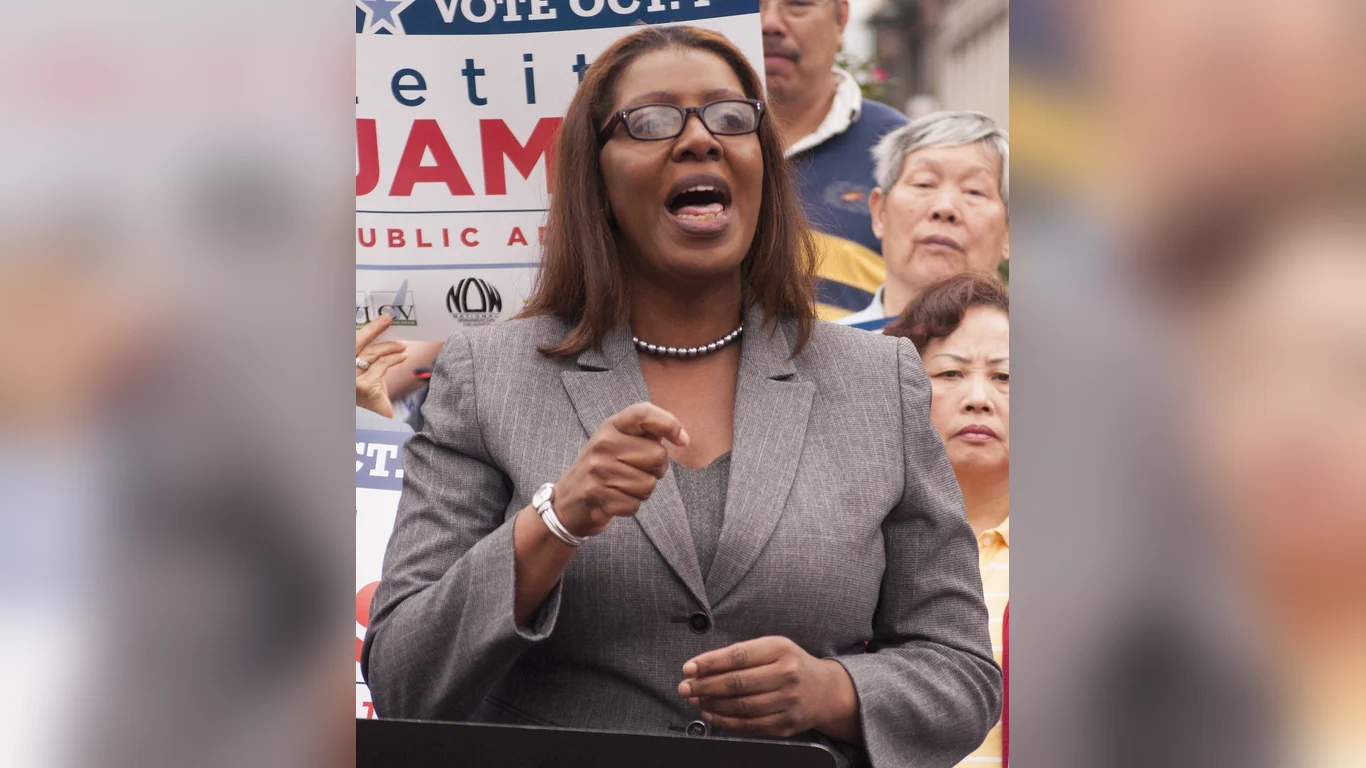
Letitia James said: “A jury found what we have long known to be true: Live Nation and Ticketmaster are breaking the law and costing consumers millions of dollars in the process.”4 Roger Alford, who once worked on antitrust at the Justice Department, told NPR: “This was a massive win for the state AGs and an historic miss for the DOJ.”46 Kessler said: “There are lots of ways we could have had less than a total victory … but this was a total victory.”9

Live Nation said: “The jury’s verdict is not the last word on this matter.”47
What has happened since
Two days after the verdict, Live Nation’s lawyers wrote that for every state the jury had copied the economist’s top figure “to the cent”, and asked the judge to throw out her evidence and the damages with it. He refused to rush, and wrote that their tone was “inconsistent with the Court’s rule requiring civility”.48
In July, Live Nation asked him to scrap the verdict or order a new trial. Its lawyers wrote that Baker’s messages had unfairly swayed the jury: “Of course this evidence was prejudicial; the impact could hardly be more stark”.49 The states want Live Nation made to sell Ticketmaster, so that promoter and ticket seller would be separate firms again. The judge heard Live Nation’s case on 31 July and questioned the evidence.50 He has still not ruled on whether the verdict stands.
The government’s own deal with Live Nation is a separate case, and it still needs Judge Subramanian’s approval. Seventeen of the winning states, along with Washington DC, want him to reject it.51 No date has been set for either ruling, and a hearing on a breakup is not expected before February 2027.52
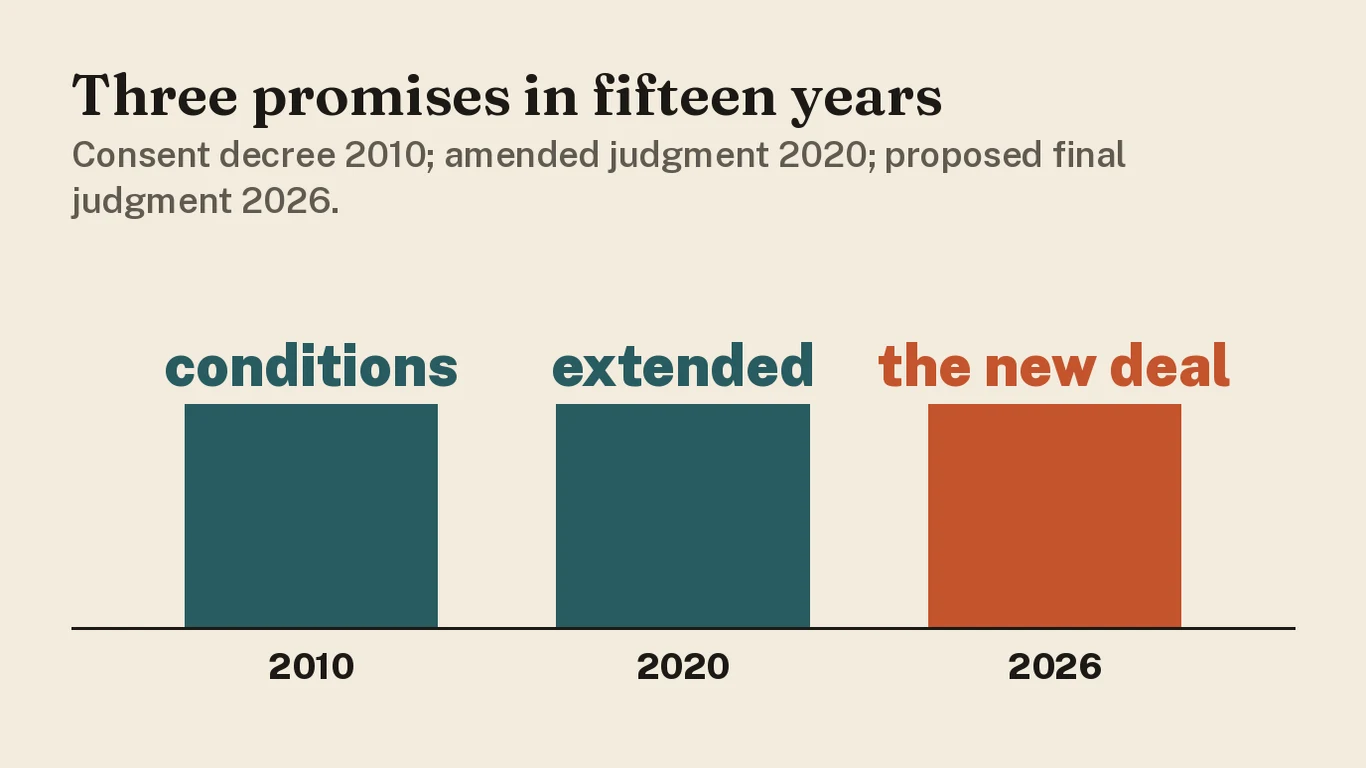
In March, Live Nation’s lawyer had asked SeatGeek’s boss, Jack Groetzinger, whether the lawsuit helped his business. He told the jury: “Absolutely.”53 SeatGeek has since commented publicly on the government’s deal: “The settlement asks Live Nation to promise, for the third time in fifteen years, not to do what a jury just found illegal.”54 The first two were the 2010 conditions and their extension in 2020. If the judge approves the deal, its rules will bind Live Nation for eight years.28
Not a cent of the $1.72 has been paid yet, to the states or to any fan.55 For now, whether it is ever paid rests with Judge Subramanian.

Live Nation contests the verdict, and its motions for a new trial and to set the verdict aside were undecided when this was written. Nobody in this story has been charged with a crime; the case is a civil antitrust case.
Sources
-
Paul Weiss, client memo on the verdict, and Crowell, “After the Verdict”: the jury’s findings on every claim, and $1.72 for each primary concert ticket sold under the conduct found. The four days of deliberation are from Fortune and the AP. ↩ ↩2
-
Live Nation 2025 annual report (10-K), segment note: Ticketing adjusted operating income of $1,134.4 million. The annual report itself: “approximately 346 million tickets in 2025” on which fees were paid. Adjusted operating income is the company’s own profit measure. ↩
-
Our arithmetic: $1,134.4 million divided by 346 million is $3.28; $1.72 is 52 per cent of $3.28. The comparison is of scale only: the $1.72 covers concert tickets at 257 venues, and the $3.28 is a worldwide average across every kind of ticket. ↩
-
New York Attorney General, 15 April 2026: New York and “a coalition of 33 other attorneys general”, a count that includes Washington DC’s; and Letitia James’s words on the verdict. ↩ ↩2
-
US Department of Justice, 23 May 2024, and the case page. ↩ ↩2
-
US Department of Justice, Competitive Impact Statement: the term sheet signed on 5 March 2026. The settlement was made public on 9 March, the trial’s second week; the verdict came on 15 April. ↩ ↩2
-
New York Attorney General, 15 April 2026, and PBS NewsHour, 9 March 2026. ↩
-
Rolling Stone interview with Jeffrey Kessler, 16 April 2026, as carried by Yahoo Finance: the eight days, the states’ lack of a lead trial lawyer of their own, “directed from elsewhere”, the Slack messages, calling Baker early, “all of these admissions” and “a total victory”. Kessler gave the same count of eight days on the Law Disrupted podcast. ↩ ↩2 ↩3 ↩4 ↩5 ↩6 ↩7 ↩8
-
Creative Loafing Tampa: the 2022 Slack exhibit, quoted in lower case as in the exhibit, and Baker’s 2022 title, regional ticketing director. Live Nation’s description of “one junior staffer” is from Courthouse News, 17 March 2026. ↩ ↩2 ↩3
-
US Department of Justice, 23 May 2024: “roughly 80% or more of major concert venues’ primary ticketing”. ↩
-
Senate Judiciary Committee hearing, “That’s the Ticket”, 24 January 2023 (S. Hrg. 118-31), Clyde Lawrence: “The tickets were listed at $30, and our pay ended up shaking out to about $12 of each ticket”. The show was an illustration, as he described it. ↩
-
US Department of Justice, Competitive Impact Statement, page 5: “Live Nation also owns and operates a significant number of large amphitheaters”. ↩
-
Live Nation full-year 2025 results: Concerts adjusted operating income of $687.1 million on revenue of $20,860.7 million (3.3 per cent); Ticketing adjusted operating income of $1,134.4 million on revenue of $3,081.2 million (36.8 per cent). ↩
-
US Department of Justice, case page for United States v. Ticketmaster Entertainment and Live Nation: the consent decree of January 2010. ↩
-
Christine Varney, “The Ticketmaster/Live Nation Merger Review and Consent Decree in Perspective”, South by Southwest, Austin, 18 March 2010. ↩ ↩2
-
US Department of Justice, December 2019, and January 2020: the court entered the modified judgment, extending the conditions to the end of 2025. ↩
-
Ticketmaster, “Taylor Swift | The Eras Tour Onsale Explained”, 19 November 2022: “3.5 billion total system requests – 4x our previous peak”. ↩
-
Senate Judiciary Committee hearing, 24 January 2023: Joe Berchtold, and Clyde Lawrence in his oral evidence. ↩ ↩2
-
Live Nation 2025 annual report: “Venues set the ticketing service fee to be charged on tickets and typically retain the majority” of it. ↩
-
Digital Music News, 5 March 2026, on John Abbamondi’s testimony. ↩ ↩2
-
NBC New York, on Abbamondi’s testimony and the recorded call, and the arena’s return to Ticketmaster in 2023. ↩ ↩2
-
Norman Oder, Atlantic Yards Report, on Abbamondi’s testimony. NBC New York gives a different count: an agreement for 25 shows that delivered fewer than ten. ↩
-
Senators Klobuchar, Warren and colleagues, letter to the court, April 2026: “Slater was ousted from her position on February 12”, the trial team’s absence from the settlement talks, and reports that the terms were negotiated at the White House. These are the senators’ account of press reports. ↩ ↩2
-
US Department of Justice, Competitive Impact Statement: no service fees above 15 per cent for tickets sold through Ticketmaster at Live Nation’s large amphitheatres; the six settling states; and a judgment that runs eight years from entry. ↩ ↩2 ↩3
-
US Government Accountability Office, GAO-18-347, 2018: primary and secondary ticket sellers “charged total fees averaging 27 percent” of a ticket’s price. ↩
-
PBS NewsHour (AP), 9 March 2026: the unnamed official on a call with reporters, and Letitia James’s statement. ↩ ↩2
-
Winston & Strawn, Jeffrey Kessler’s biography: McNeil v. NFL and the players’ union’s case for Tom Brady. ↩
-
Courthouse News, 17 March 2026, and Malay Mail (AFP), 18 March 2026. ↩
-
Digital Music News, 18 March 2026: his two promotions, his present role and his answer on pay. ↩
-
WPSD (AP), March 2026: Rapino on Baker’s messages and on fees, and his 2019 deposition, read in court. ↩ ↩2
-
Big Tech on Trial, day 13, 25 March 2026: about $2.30 a ticket more than AXS, 68 to 75 per cent passed on, the cross-examination on AXS’s service, and “increased year-by-year”. $2.30 times 68 per cent is $1.56, and times 75 per cent is $1.72. ↩ ↩2 ↩3
-
Digital Music News, 9 April 2026, on the closing speeches. ↩
-
Digital Music News, 9 April 2026, and the AP’s report of the closing speeches. ↩
-
NPR, 16 April 2026: “$1.72 per ticket in 22 states”; Paul Weiss: 257 venues over the past five years. ↩
-
Live Nation statement, 15 April 2026: “the aggregate single damages figure would be below $150 million”. ↩
-
Section 4 of the Clayton Act trebles damages. $150 million times three is $450 million; Crowell says the total “could approach $450 million before offsets”. ↩
-
Live Nation full-year 2025 results: net income attributable to common stockholders of $496.0 million. $450 million is about nine-tenths of it. ↩
-
Live Nation’s statement on the verdict, 15 April 2026, as reported by Fortune. ↩
-
TicketNews, 21 April 2026, on Live Nation’s letter motion of 17 April and the judge’s reply. ↩
-
TicketNews, September 2026, on the comment filed on 4 September 2026 by 17 states and Washington DC. ↩
-
TicketNews, 1 October 2026: the post-trial motions and the decision on the government’s deal both pending. Courthouse News, May 2026: no hearing on a breakup before February 2027. ↩
-
TicketNews, September 2026, on SeatGeek’s comment of 31 August 2026. ↩
-
TicketNews, 1 October 2026: no judgment or remedy has been entered, so no damages have been paid. ↩