 Open Books

$32,000 on the raid
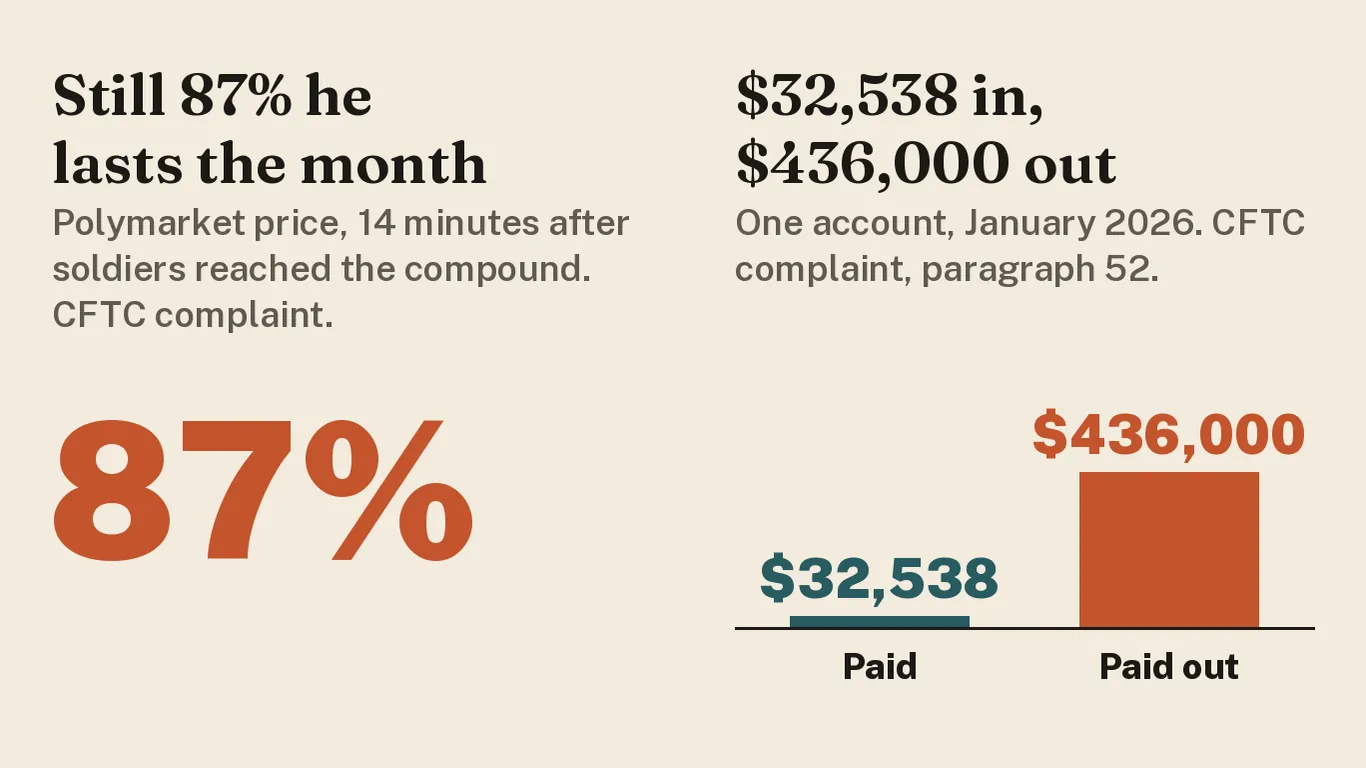
At one minute past one on the morning of 3 January 2026, New York time, American soldiers reached Nicolás Maduro’s compound in Caracas.1 Fourteen minutes later, on the betting site Polymarket, a “Yes” share in Maduro being gone by the end of the month still cost less than thirteen cents. The market was still giving him a better than 87 per cent chance of lasting the month.2
One account had bet about $32,000 that he would be gone. By breakfast, that bet had paid $436,000.3


Prosecutors say the account belonged to a Special Forces master sergeant who had helped plan the raid.4 Three days after the raid, prosecutors say, the sergeant asked Polymarket to delete the account.5 Nine months on, a federal judge in Manhattan is still being asked whether buying those shares was against the law.6
The sergeant is Gannon Ken Van Dyke. He faces five charges. The charges are allegations, and he has not been convicted. He has pleaded not guilty.7
What a 13-cent share buys
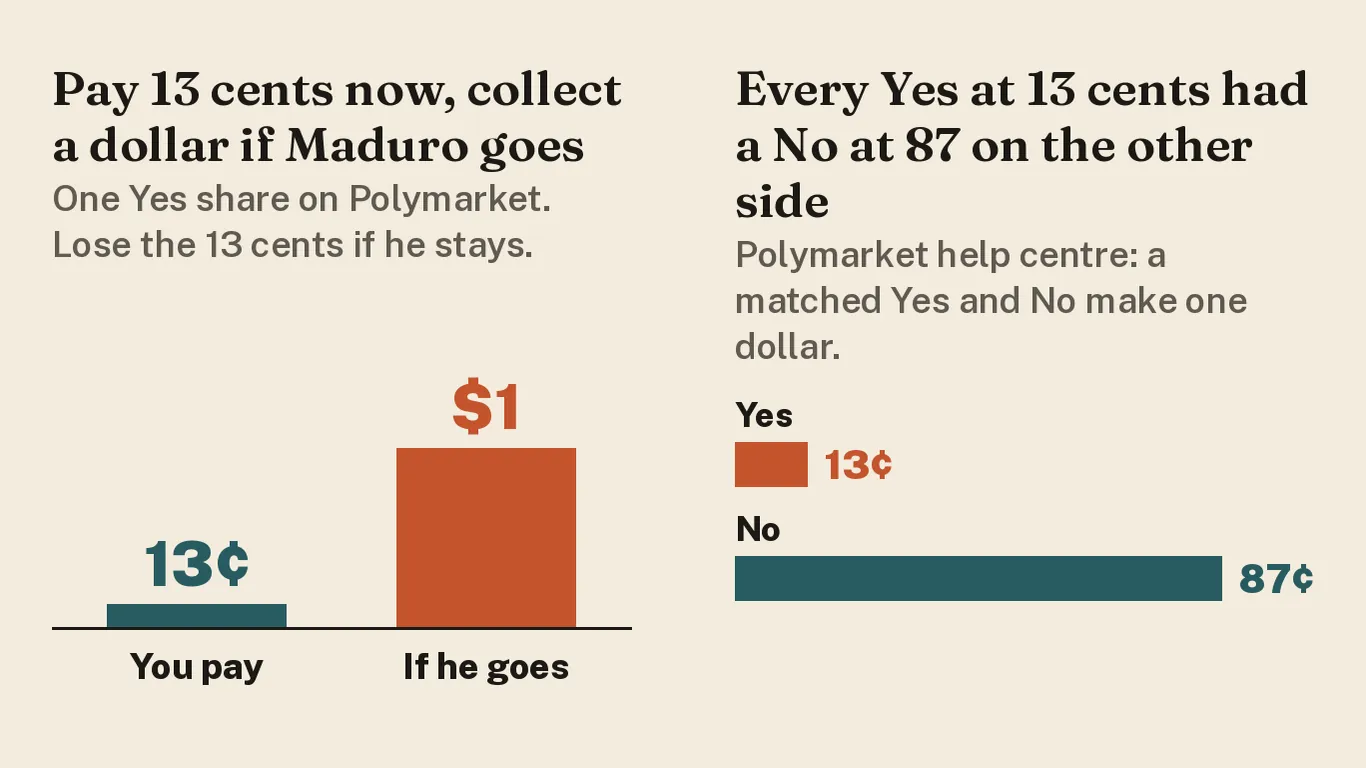
On Polymarket, a “Yes” share in Maduro being gone cost thirteen cents. Anyone who bought one got a dollar back if he went, or lost the thirteen cents if he stayed.8
Polymarket’s own help pages say its prices come from its order book, which is traders buying from and selling to each other. A “Yes” and a “No” are matched against each other and together make one dollar. So every “Yes” bought at thirteen cents had somebody on the other side holding “No” at 87.9
A price of thirteen cents means the people trading it, between them, put the chance at thirteen in a hundred.10
From 29 December until the soldiers were in Caracas, the crowd’s price for Maduro being out of power that month stayed below thirteen cents.2 The account prosecutors would later trace to the sergeant had paid an average of about seven and a half cents a share.3
The account Fortune found
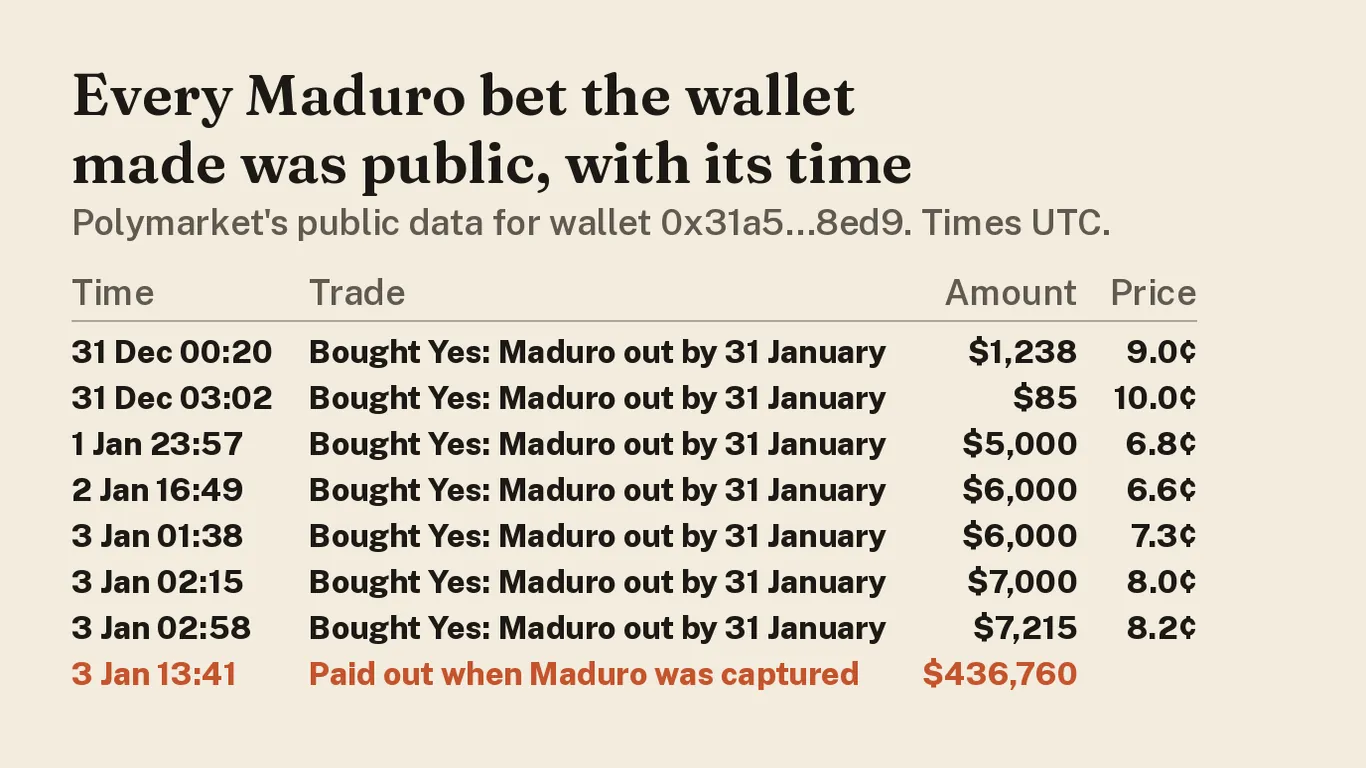
Fortune magazine found the account two days after the raid. On 5 January, Fortune reported on a Polymarket account, opened only days before the raid, that had made more than $400,000 betting only on Maduro and on war with Venezuela.11 Fortune linked to the account’s public page.

Every trade on Polymarket is written to a public blockchain, so anyone with the address could see what the wallet had bought, and at what time.12
A wallet address carries no name, and a bank account does. The Commodity Futures Trading Commission’s complaint says the account had been opened under the name “Burdensome-Mix”.13 According to the complaint, the money in the wallet had come from an account at a crypto exchange in the United States. The complaint says the money at the exchange had arrived in late December, about $35,000 from a personal bank account.14
The bank account, the complaint says, belonged to Gannon Ken Van Dyke.14
A Master Sergeant at Fort Bragg
Van Dyke had served in the Army’s Special Forces since September 2008. He was 38 when he was charged, a master sergeant based at Fort Bragg in North Carolina.15 The complaint says Van Dyke was involved in planning and carrying out Operation Absolute Resolve, the raid that captured Maduro.4
In November 2025, the complaint says, Van Dyke saved to his Google account a screenshot of an answer from an artificial intelligence tool. The answer said that Special Forces have “numerous classified files, records, and operational details that are not available to the public,” and the complaint cites it to show Van Dyke knew how secret his work was.16

In early December, prosecutors say, Van Dyke signed a nondisclosure agreement. The agreement, as the Justice Department quotes it, bound him to “never divulge, publish, or reveal by writing, words, conduct, or otherwise” any classified or sensitive information.17
About a week later, prosecutors say, Van Dyke created a new email address that was not in his name.18
On or about 26 December, the complaint says, Van Dyke moved the $35,000 to the exchange and opened Burdensome-Mix the same day.19
Three trades before the order
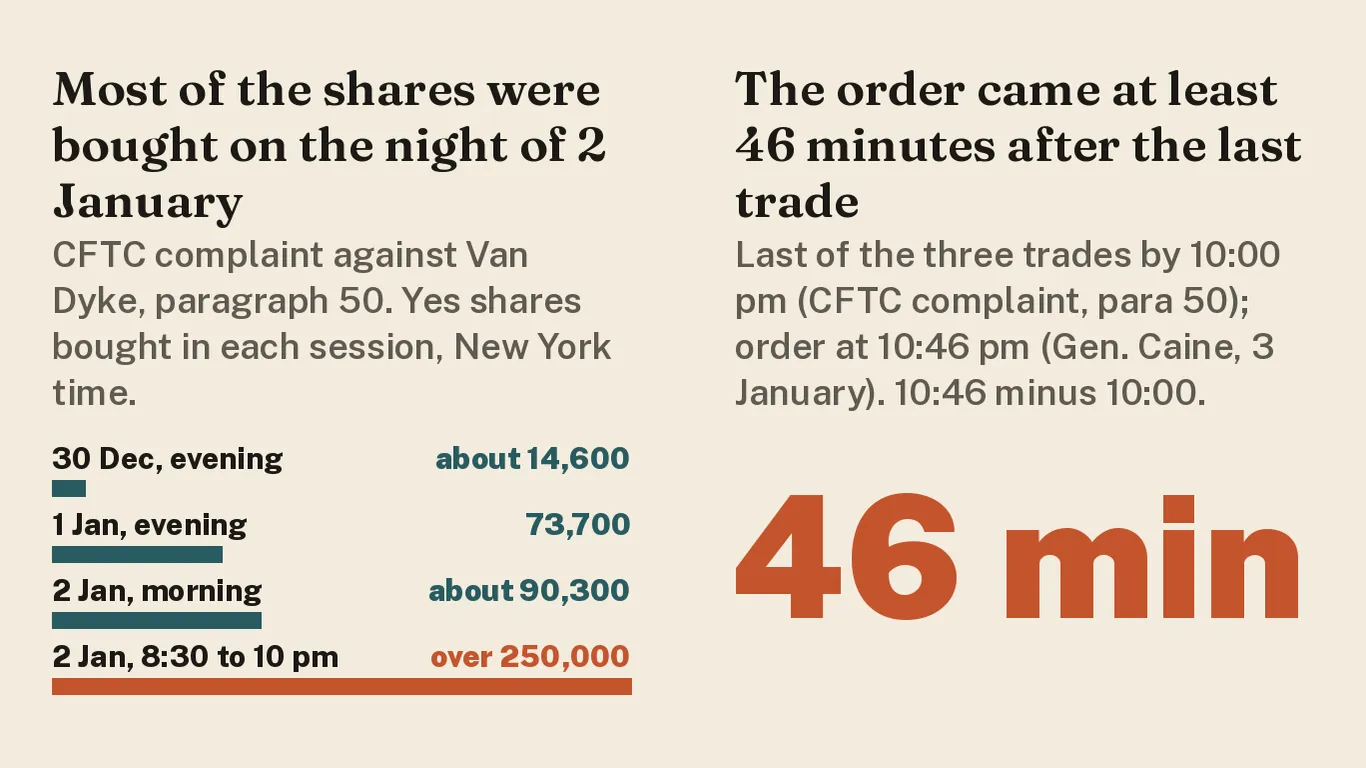
On the evening of 30 December, the complaint says, Burdensome-Mix made its first purchase of “Yes” shares in Maduro being out of power by the end of January. The account bought more on the evening of New Year’s Day, and more on the morning of 2 January.20
Between half past eight and ten o’clock on the evening of 2 January, in three trades, the account bought more than 250,000 shares.20 More than half of the Maduro shares the account would ever hold were bought in those ninety minutes.21

At fourteen minutes to eleven that night, President Trump ordered the military to go ahead, according to the account General Dan Caine gave at a briefing the next day.1 The order came at least 46 minutes after the last of the three trades.22
Four minutes
At one minute past one in the morning, General Caine said, the soldiers were at Maduro’s compound.1 The complaint says the price of a “Yes” share had still not passed thirteen cents at a quarter past one.2

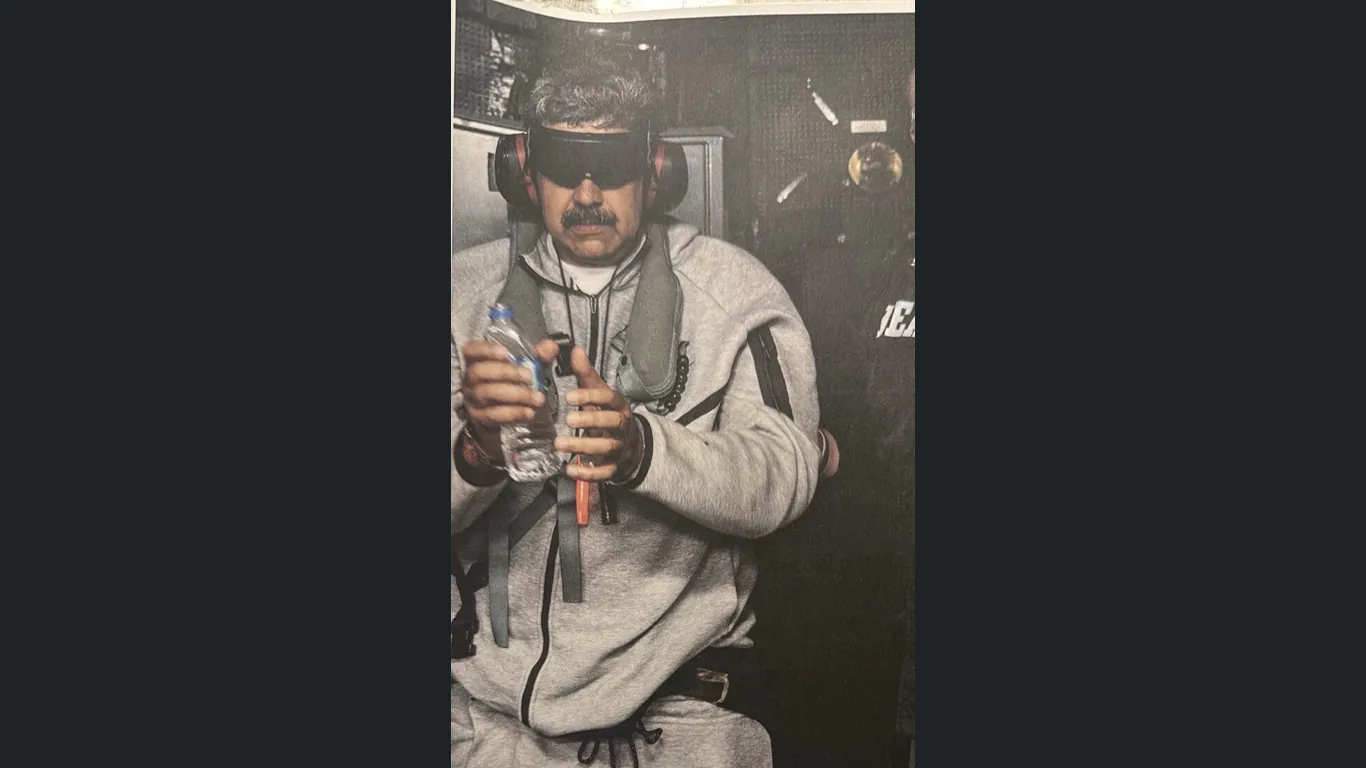
By half past three the soldiers were over the water, General Caine said, and Maduro was taken aboard the USS Iwo Jima.1

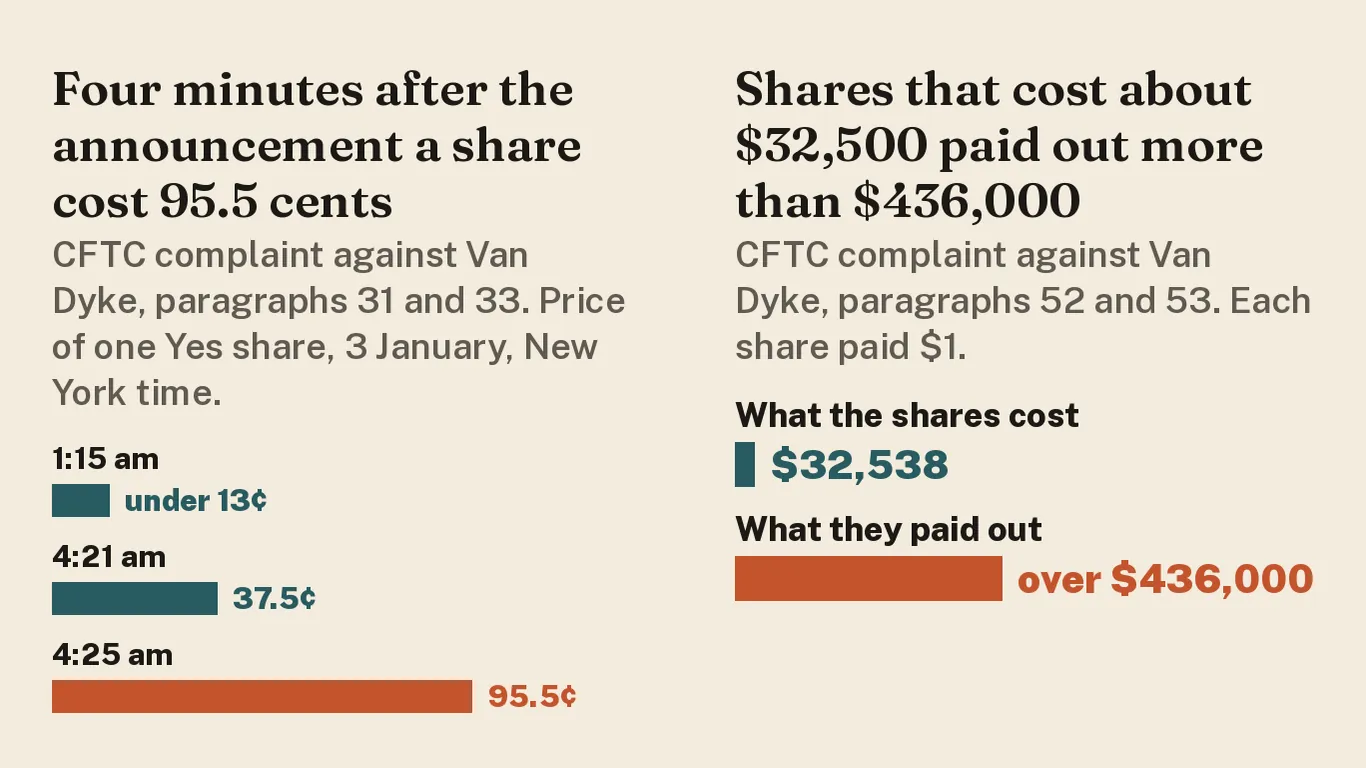
At twenty-one minutes past four in the morning, President Trump announced that American forces had captured Maduro. At that minute a “Yes” share cost 37.5 cents. At twenty-five past four a share cost 95.5 cents.23
Later that morning Polymarket settled the bet at “Yes”, and every share in Van Dyke’s account paid one dollar.3 The shares had cost the account about $32,500. For every dollar spent on them, about $13.40 came back.24 The complaint puts the account’s profit at more than $404,000.3
Deleting the account
The Justice Department says Van Dyke withdrew most of the money from Polymarket that same day.25
On 6 January, the day after Fortune’s story, prosecutors say Van Dyke asked Polymarket to delete his account, telling the site, falsely, that he had lost access to the email address behind it. On the same day, prosecutors say, he changed the email on his crypto exchange account to the address he had created in December, the one that was not in his name.5

The Justice Department says most of the winnings went to what it calls a foreign cryptocurrency vault, and from there into a newly opened online brokerage account.25 On 15 January, the complaint says, Van Dyke exchanged the crypto he had won for $444,209 in American dollars.26

The arrest
On 23 April 2026, the Justice Department announced Van Dyke’s arrest and five charges against him. FBI Director Kash Patel said: “Any clearance holders thinking of cashing in their access and knowledge for personal gain will be held accountable.”27 Polymarket issued a statement: “Insider trading has no place on Polymarket. Today’s arrest is proof the system works.”28
The arrest came fifteen weeks after Fortune had printed the wallet address.29

Van Dyke was released on a bond of $250,000. On 28 April, in federal court in Manhattan, he pleaded not guilty before Judge Margaret Garnett.7
The Commodity Futures Trading Commission said it had never before charged anyone with insider trading on an event contract, its name for a bet like the one on Maduro.30

Van Dyke’s account was a long way from the first on Polymarket to buy before the news. The difference between his case and the others is what the complaint found at the end of the money.14
The Nobel winner, ten hours early
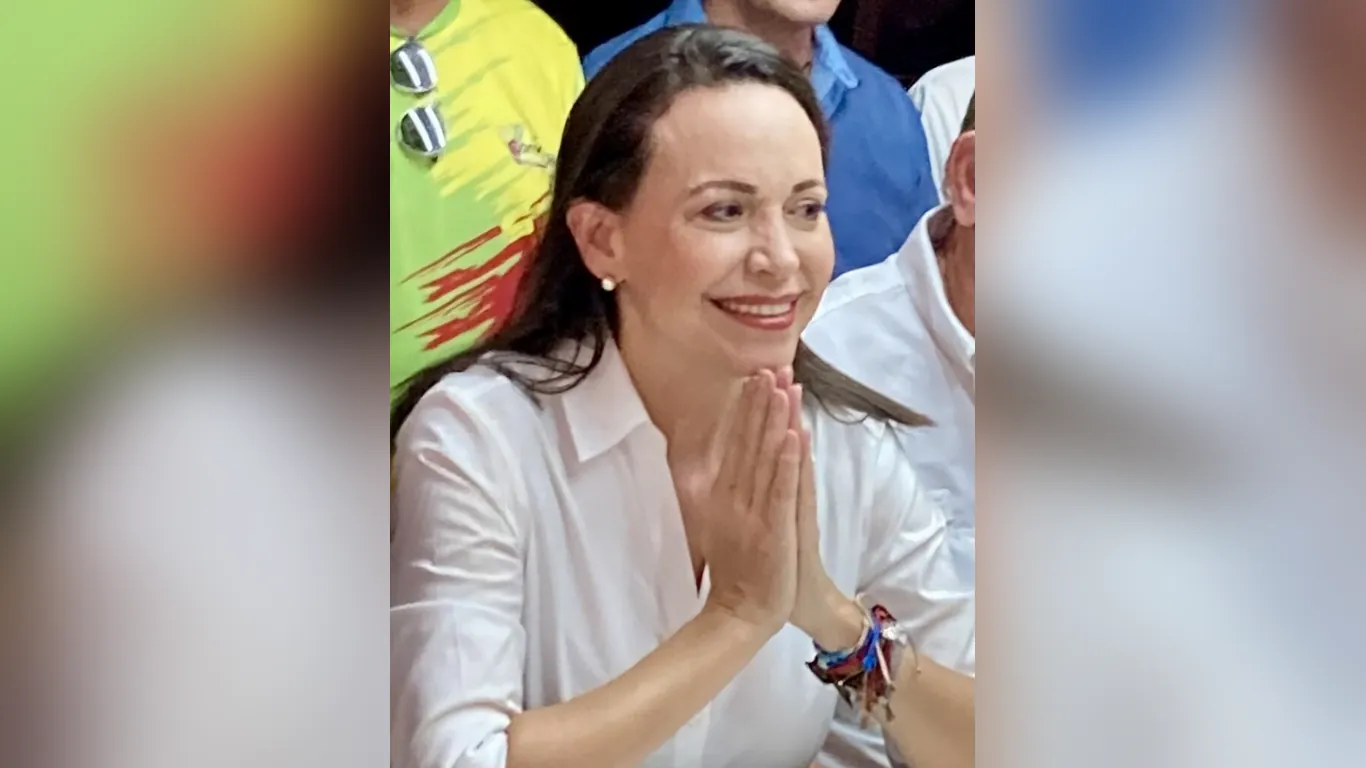
On 10 October 2025, the Norwegian Nobel Committee named María Corina Machado, the Venezuelan opposition leader, the winner of the Peace Prize. The committee had chosen Machado a few days earlier, and until that morning nobody outside the room was supposed to know the name.31

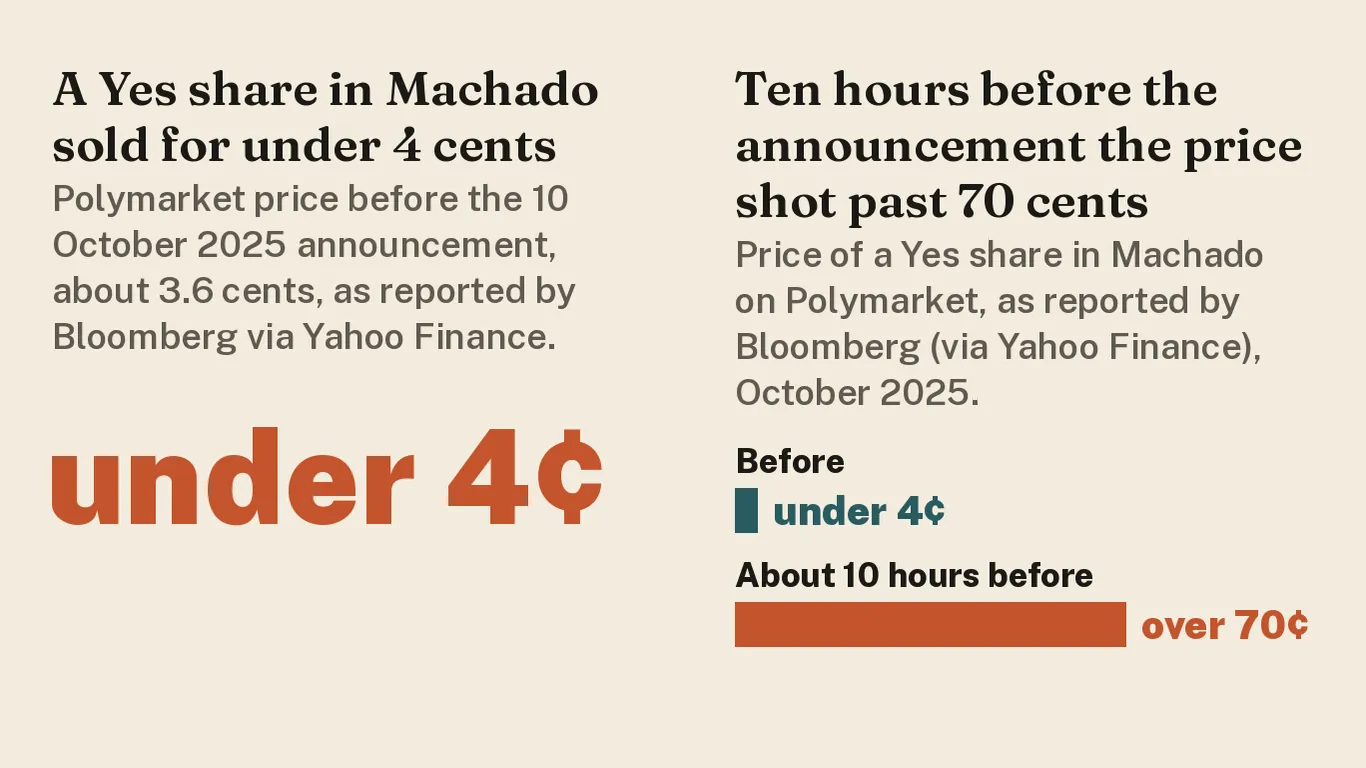
On Polymarket, a “Yes” share in Machado had been selling for less than four cents. About ten hours before the announcement, Bloomberg reported, the price shot up to more than seventy cents.31
One account, which posted as dirtycup and had never placed a bet before, backed Machado and made about $30,000.32
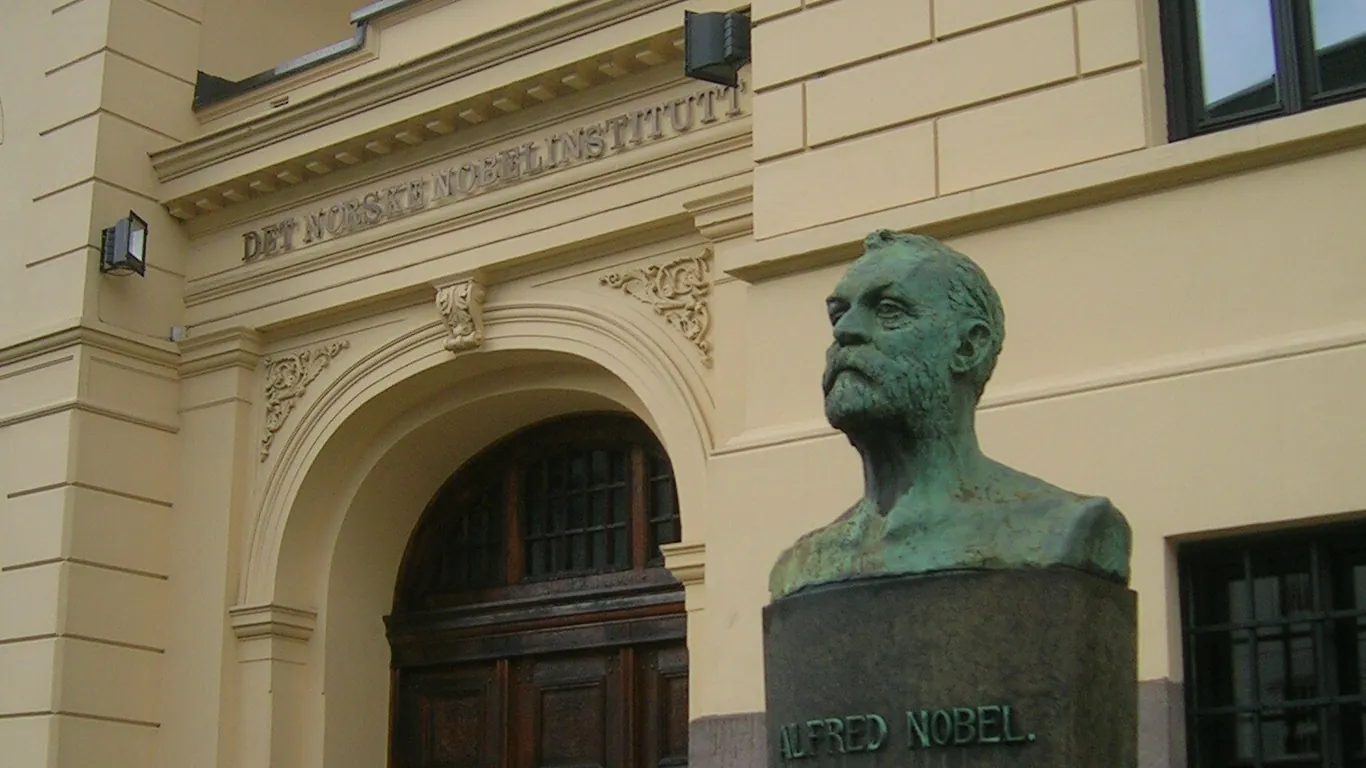
Kristian Berg Harpviken, the director of the Norwegian Nobel Institute, said the next day: “It seems we have been prey to a criminal actor who wants to earn money on our information.”32 “Secrecy for us is very important,” Harpviken said.31
In January 2026 Harpviken said the Institute believed it was most likely “a case of digital intrusion”, with someone getting into its systems. The Institute has named nobody, and has not said how its secret got out.33

The money in the sergeant’s case had a path with his name at the start of it: his own bank account, then an American crypto exchange that knew who its customer was, then the Polymarket wallet, and, the complaint says, back again on 3 and 4 January with the winnings.26 The money behind dirtycup has been traced, publicly, to nobody.33
Six wallets and the Iran strikes
Eight weeks after the Maduro raid, with the wallet Fortune had printed still public and nobody arrested, American and partner forces began bombing Iran, at a quarter past one on the morning of 28 February, New York time.34

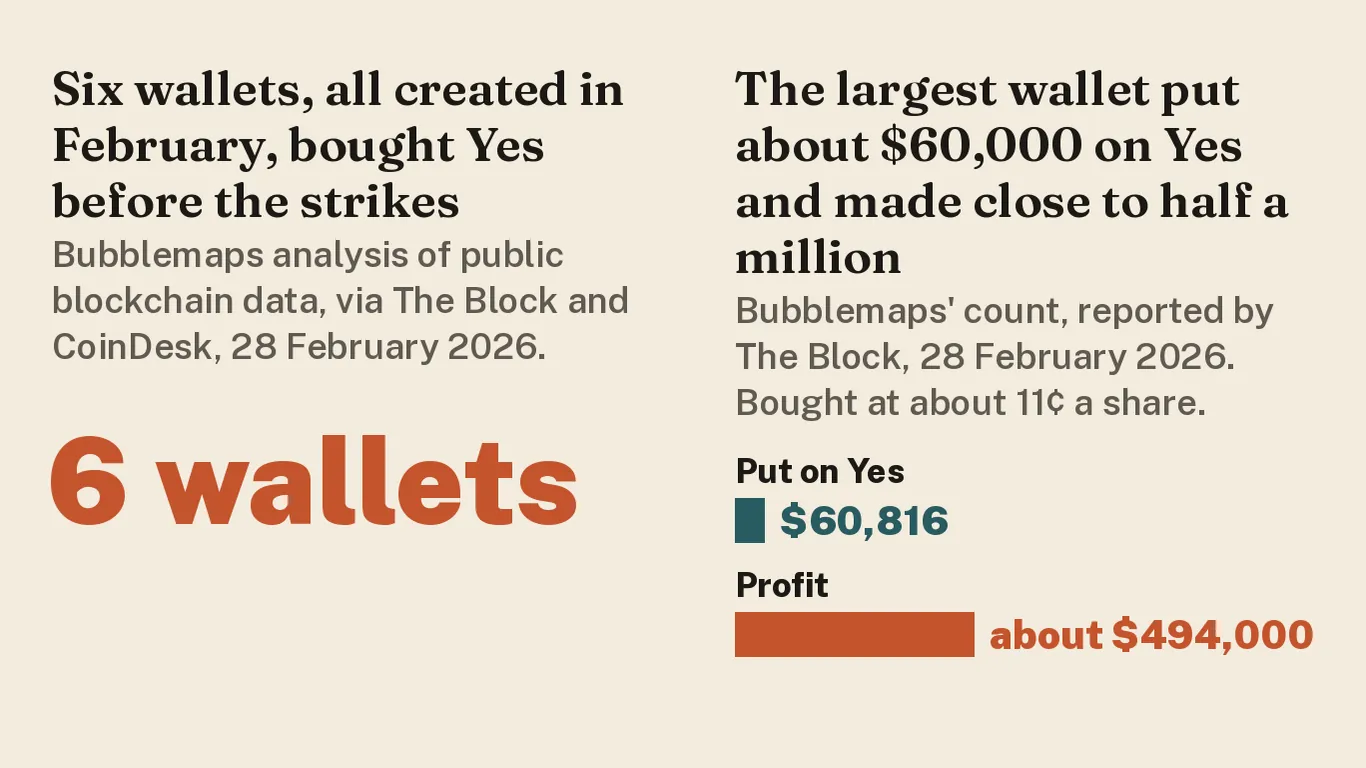
Polymarket had a market on whether the United States would strike Iran by that date. Bubblemaps, a blockchain analytics firm, reported that six wallets, all created that month, had bought “Yes” in the hours before the first explosions.35 The largest of the six wallets, by Bubblemaps’ count, put roughly $60,000 on “Yes” at eleven cents a share and made close to half a million.36
Nicolas Vaiman, the chief executive of Bubblemaps, said that “given the size of the bets, the freshly funded wallets, and the timing around the bets, it felt convincing enough for us to share.” Vaiman also said that in such cases it was “almost impossible to be 100 per cent certain”.36 No charge has been brought over the six wallets.37
In an interview broadcast by CBS’s 60 Minutes in November 2025, a month before Van Dyke opened his account, Polymarket’s chief executive Shayne Coplan had said: “I think that people going and having an edge to the market is a good thing.”38
The trader who paid for his own polls
The largest win in any of these stories went to a French trader who paid for what he knew.39
In the weeks before the American election of November 2024, a French trader who gave his name as Theo put about $30 million into Polymarket on Donald Trump winning, by his own account to the Wall Street Journal. Theo told the Journal he did not trust the published polls.40

Theo said he had commissioned his own surveys, which asked people how they thought their neighbours would vote, and that the results were “mind-blowing to the favor of Trump”. He declined to publish the surveys, saying he had commissioned them under a confidentiality agreement.41

Trump won, and the blockchain analytics firm Chainalysis estimated that Theo made about $79 million.39 No prosecutor or regulator has accused Theo of using anybody’s secret.42 Theo told the Journal: “My intent is just making money.”40
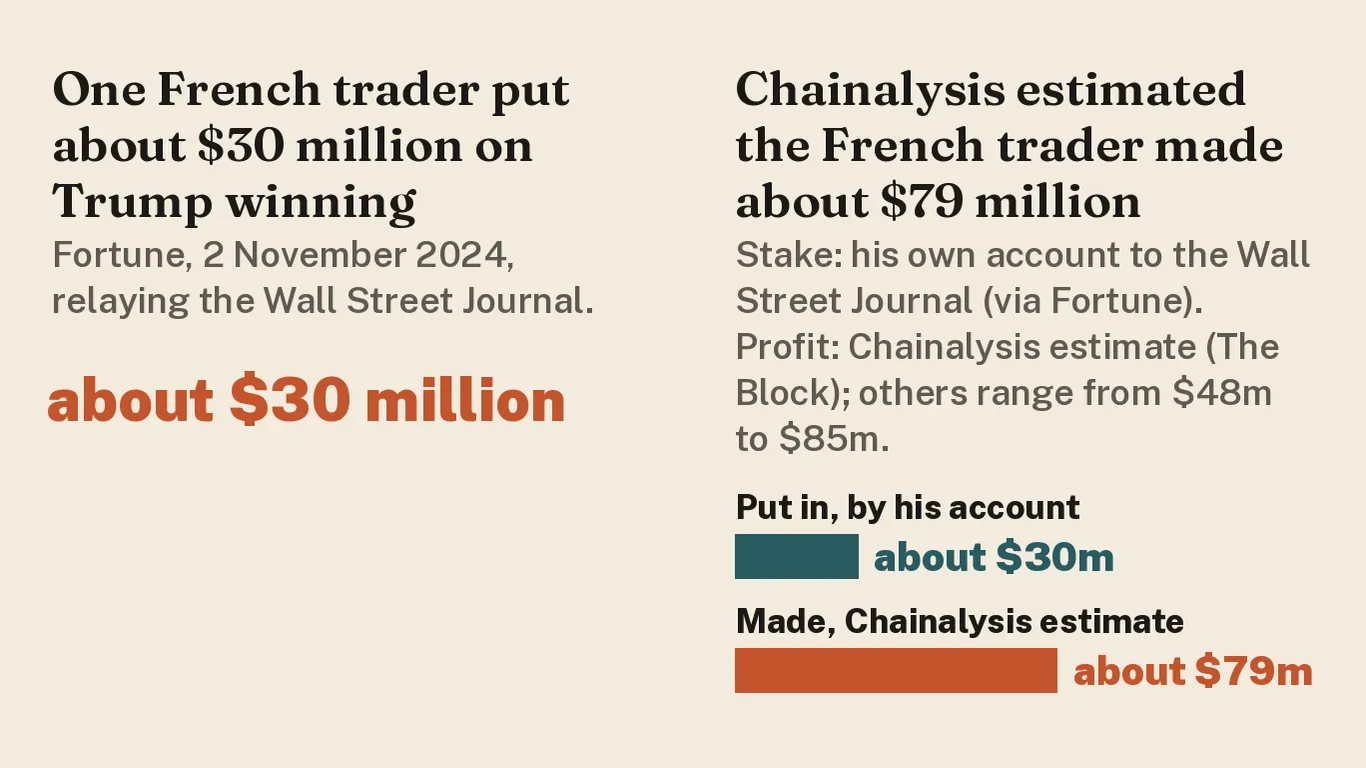
Theo paid for what he knew, and prosecutors say Van Dyke had signed a promise to keep it secret.17
A Google engineer charged
Five weeks after Van Dyke’s arrest, the same prosecutors’ office in Manhattan charged a second Polymarket bettor over somebody else’s information.43 Michele Spagnuolo was a staff software engineer at Google.44

Google publishes an annual ranking called Year in Search, and Polymarket offered bets on which person would top the 2025 list. The complaint against Spagnuolo says he used an internal company tool that showed the results before Google published them on 4 December. The complaint says the tool carried a banner, in red text, reading “Google Confidential”.44
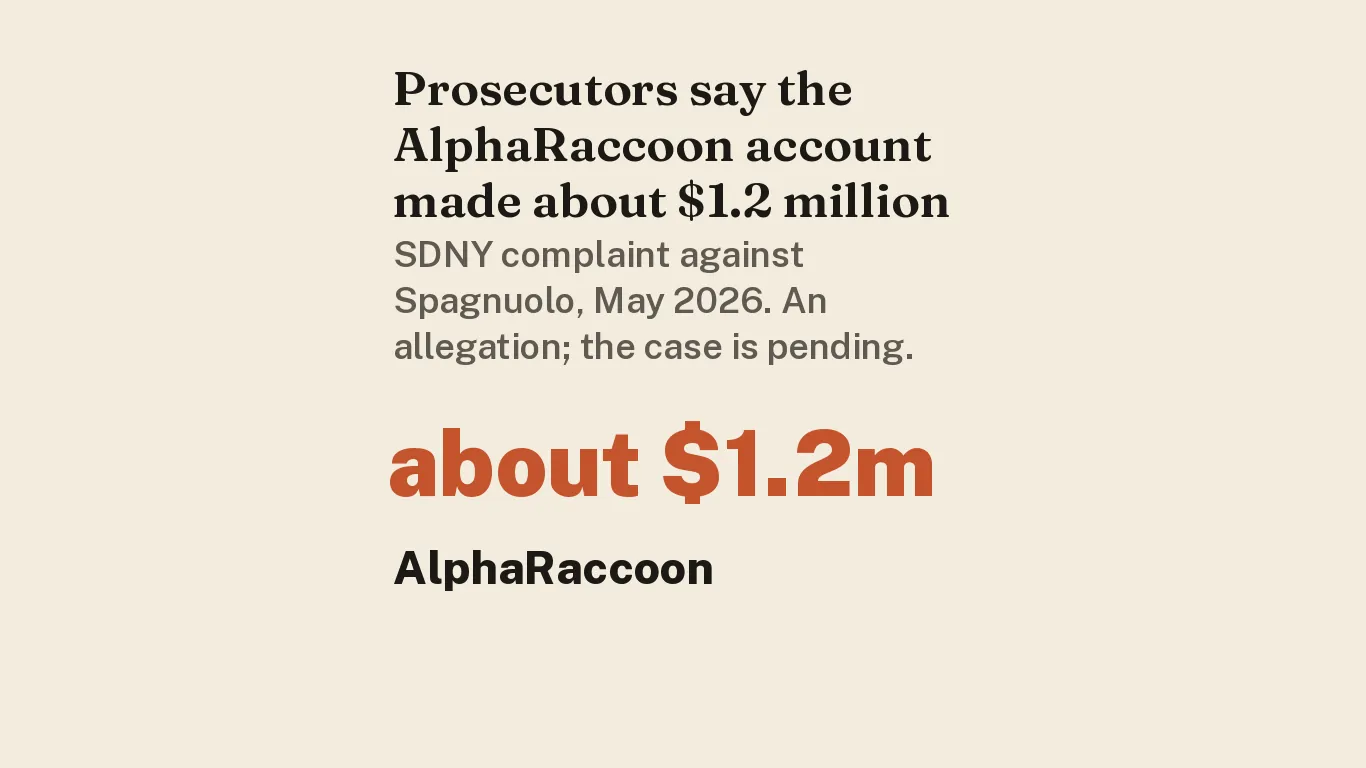
Prosecutors say Spagnuolo, betting as AlphaRaccoon, made about $1.2 million. The complaint says: “Spagnuolo knew the outcome of these wagers before the trading public did.”44 The case against Spagnuolo is pending, and he has not been convicted.43
The complaint says that even within Google, access to the Year in Search results “is restricted to only a limited number of employees.”44 Google told CBS News that Spagnuolo had used “a tool available to all employees”, and that “using such confidential information to place bets is a serious breach of our policies.”45
Spagnuolo is accused of taking a company’s secret and Van Dyke a military one, and none of the five charges against Van Dyke is a security offence.46
Which laws apply
All five charges are about trading, which is why the question in front of Judge Garnett is about what a Polymarket share is.
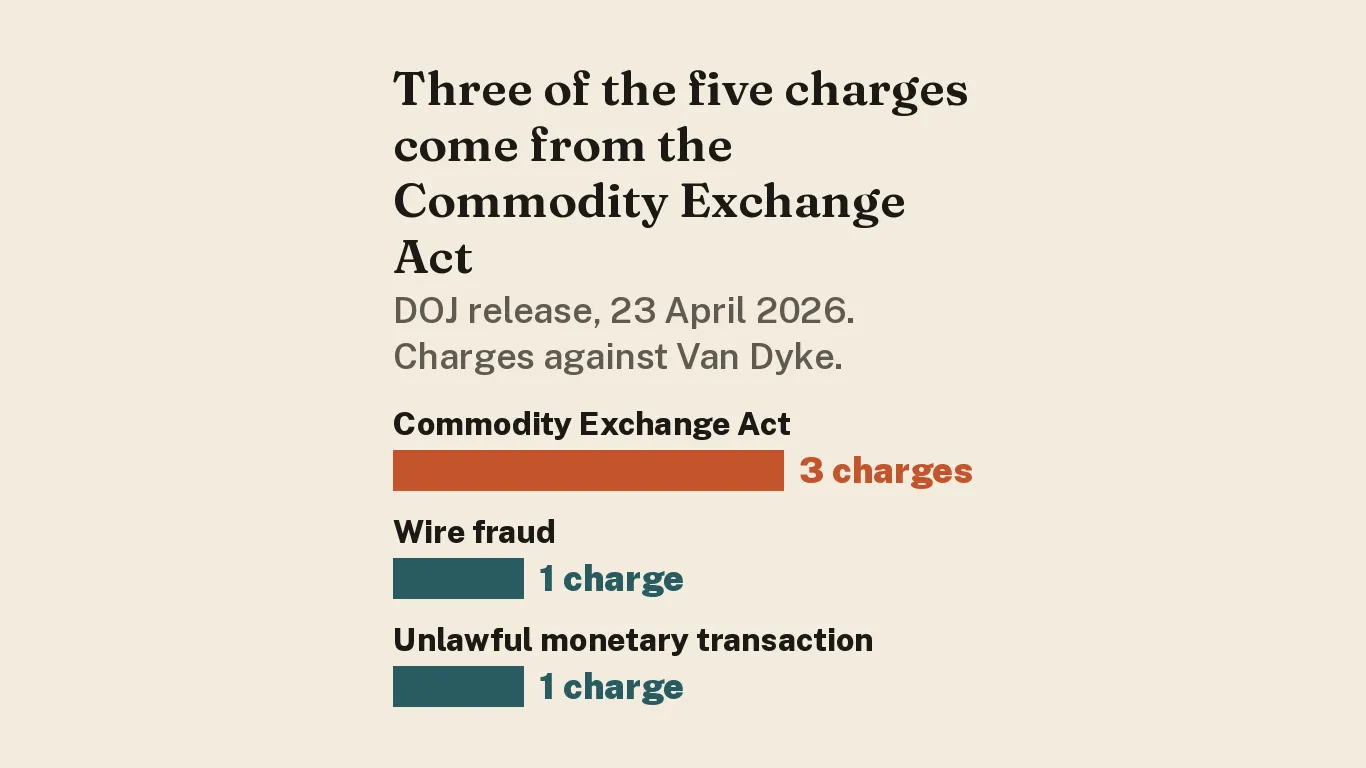
Three of the five charges against Van Dyke come from the Commodity Exchange Act, the law that governs trading in futures and swaps. The other two are wire fraud and moving the proceeds.46
Two of the commodity charges rest on a provision lawyers call the Eddie Murphy rule, after the 1983 film Trading Places, in which two rich brothers get hold of a government crop report before it is published and trade orange juice on it.47 The rule makes it a crime to trade on secret government information, and the law firm Foley says the Commodity Futures Trading Commission had never used it before this case.48

The case rests on the raid plan being a secret that Van Dyke knew he was keeping, and the complaint points to the screenshot he saved in November and the agreement he signed in December.16 Prosecutors told Judge Garnett in August that Van Dyke “took information that he had pledged to keep confidential”.49
Van Dyke’s lawyers say a Polymarket share is a wager, and that “rules meant for Wall Street trading should not apply to online bets about whether a world leader will be removed from power.”50 They say the government’s reading “would sweep every tableside bet on who will win an election into federal regulatory jurisdiction.”51

Prosecutors say the shares are financial contracts of the kind the law covers.52 The commission’s civil complaint points out that Maduro’s removal would move the price of oil and of Venezuelan bonds, risks an investor might buy such a share to protect against.47
On the wire fraud charge, Van Dyke’s lawyers say confidential information cannot be property unless it has commercial value, and a raid plan, they argue, has none.50
Judge Garnett has two plain questions in front of her. The first is: is a Polymarket share a wager, or a financial contract? The second is: is a secret military plan property?

Van Dyke’s lawyers and the prosecutors have given Judge Garnett their arguments in writing, and as of 6 October 2026 she has not ruled.6
The other side of the bet
Whatever she decides, the trades themselves are on the blockchain, and so is the other side of them.12
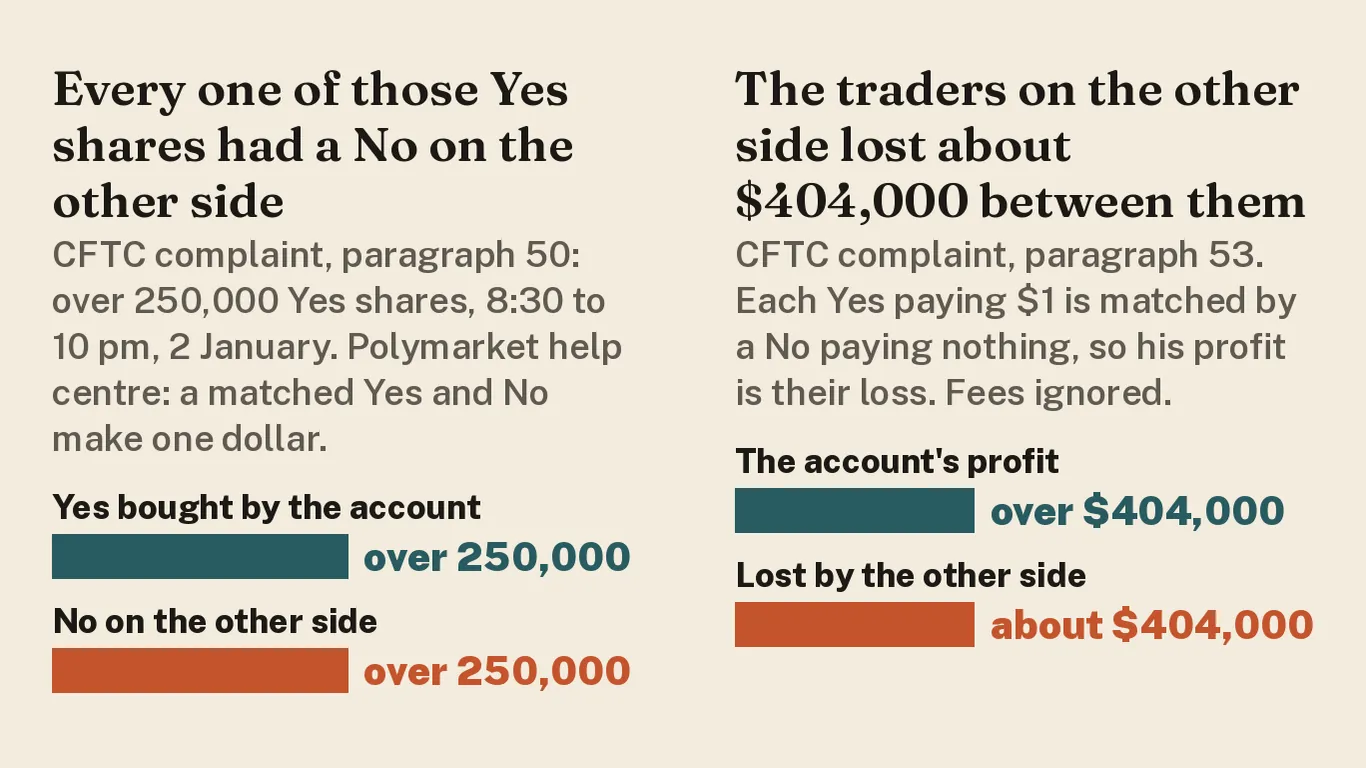
On the evening of 2 January, in the hours before the President gave the order, other traders on Polymarket took the other side of more than 250,000 “Yes” shares that Burdensome-Mix bought for less than thirteen cents each.20 The traders who took that side were holding “No” at more than 87 cents a share, against a buyer who, prosecutors say, had helped plan the raid.9

Polymarket’s chief executive had said an edge to the market is a good thing.38 The sergeant’s edge, prosecutors say, was a raid he had helped plan, and the traders on the other side of his bets lost about $404,000 to it between them.53
Van Dyke has pleaded not guilty, and the charges against him are allegations that have not been proved in court.7
Sources
-
DefenseScoop, 3 January 2026, reporting Gen. Dan Caine’s briefing: the order to go at 10:46pm Eastern on 2 January, the force at the compound at 1:01am, over the water at 3:29am, and Maduro embarked aboard the USS Iwo Jima. ↩ ↩2 ↩3 ↩4
-
CFTC complaint against Gannon Ken Van Dyke, April 2026, paragraph 31: the price of a Yes share stayed below $0.13 from 10am Eastern on 29 December 2025 through 1:15am on 3 January 2026. Fourteen minutes is 1:01am (Caine) to 1:15am (the complaint), and 100 minus 13 is 87. ↩ ↩2 ↩3
-
CFTC complaint, paragraphs 33, 52 and 53: more than 436,000 Yes shares at a total cost of about $32,538, an average of about $0.074; the market resolved Yes at about 7:14am Eastern on 3 January; more than 436,000 USDC.e received and a profit of more than $404,000. ↩ ↩2 ↩3 ↩4
-
CFTC complaint, paragraphs 9 and 34: a master sergeant, involved in the planning and execution of Operation Absolute Resolve. This is an allegation. ↩ ↩2
-
Justice Department release, 23 April 2026: on or about 6 January 2026 Van Dyke asked Polymarket to delete the account, falsely claiming he had lost access to its email address, and the same day changed the email on his exchange account to the address created in December. ↩ ↩2
-
casino.org, 2 October 2026: the defence motion to dismiss of 31 July, the prosecutors’ opposition of 19 August and a Justice Department filing of 30 September, with no ruling reported. Nine months is 3 January to early October 2026. ↩ ↩2
-
DefenseScoop, 24 April 2026: released on a $250,000 bond. PBS NewsHour, 28 April 2026: pleaded not guilty before Judge Margaret Garnett in Manhattan. ↩ ↩2 ↩3
-
CFTC complaint, paragraphs 26 and 31: a binary contract that pays $1 if the event happens, and a Yes price below $0.13. ↩
-
Polymarket help centre, “How are prices calculated”, read 4 October 2026: prices are the midpoint of the bid and ask in the order book, and a matched YES offer and NO offer total $1.00 and create one share of each. So a Yes below 13 cents has a No above 87 cents on the other side. ↩ ↩2
-
Thirteen cents of a dollar is thirteen per cent. ↩
-
Fortune, 5 January 2026: an account created less than a week before Maduro’s capture, more than $400,000 made, bets only on Maduro’s exit and war with Venezuela, and a link to the account’s public page with its wallet address. The complaint, paragraph 48, puts the account’s opening on or around 26 December. ↩
-
CFTC complaint, paragraphs 48 to 50: the wallet and its trades on the Polygon blockchain. The trade table above is from Polymarket’s public data for the wallet. ↩ ↩2
-
CFTC complaint, paragraph 48: the account name Burdensome-Mix. ↩
-
CFTC complaint, paragraphs 46 to 49: about $35,000 from Van Dyke’s personal bank account to an account at a US crypto exchange on or about 26 December 2025, and from there to the Polymarket wallet. ↩ ↩2 ↩3
-
CFTC complaint, paragraph 9: Special Forces since September 2008, based at Fort Bragg. Justice Department release, 23 April 2026: Van Dyke, 38. ↩
-
CFTC complaint, paragraphs 35 and 38: the screenshot saved in or around November 2025, quoted in the complaint, and the nondisclosure agreement. ↩ ↩2
-
Justice Department release, 23 April 2026: the nondisclosure agreement signed on or about 8 December 2025, quoted as “never divulge, publish, or reveal by writing, words, conduct, or otherwise”. The CFTC complaint, paragraph 35, prints “writing, word, conduct, or otherwise”. ↩ ↩2
-
Justice Department release: an email address created on or about 14 December 2025 that was not subscribed in his name. ↩
-
CFTC complaint, paragraphs 46 and 48: the transfer and the account opening, both on or about 26 December 2025. ↩
-
CFTC complaint, paragraph 50: about 14,600 shares on the evening of 30 December, 73,700 on the evening of 1 January, about 90,300 on the morning of 2 January, and more than 250,000 in three transactions between 8:30pm and 10pm Eastern on 2 January. ↩ ↩2 ↩3
-
250,000 of 436,000 is about 57 per cent (complaint, paragraphs 50 and 52). ↩
-
10:46pm (Caine) minus 10pm, the end of the window in the complaint, is 46 minutes. It is at least 46 minutes because the last trade may have come earlier in the window. ↩
-
CFTC complaint, paragraphs 32 and 33: the President’s post at or around 4:21am Eastern, a Yes price of $0.375 at 4:21am and $0.955 at 4:25am. ↩
-
436,000 divided by 32,538 is 13.40 (complaint, paragraphs 52 and 53). ↩
-
Justice Department release: he withdrew the majority of the proceeds the same day as the operation, and “sent most of his proceeds to a foreign cryptocurrency vault before depositing them into a newly created online brokerage account”. ↩ ↩2
-
CFTC complaint, paragraphs 58 and 59: winnings moved to the exchange account on 3 and 4 January 2026, and USDC exchanged for $444,209 on 15 January. The complaint says the dollars went to his personal account at a US bank; the Justice Department release describes a vault and a brokerage account. Each document’s account is given here as it stands. ↩ ↩2
-
Justice Department release, 23 April 2026: the arrest, the five charges, and FBI Director Kash Patel’s statement. ↩
-
ABC News, 24 April 2026: Polymarket’s statement. ↩
-
5 January to 23 April 2026 is 108 days, a little over fifteen weeks. ↩
-
CFTC release 9217-26, 23 April 2026: the first time the commission had charged insider trading involving event contracts. ↩
-
Yahoo Finance, reporting Bloomberg, October 2025: Machado named on 10 October 2025 after a decision taken a few days earlier; a price of about 3.6 cents rising past 70 cents roughly ten hours before the announcement; and Harpviken’s “Secrecy for us is very important”. ↩ ↩2 ↩3
-
CoinDesk, 11 October 2025: the account dirtycup, about $70,000 staked and more than $30,000 profit, and Harpviken’s statement. Yahoo Finance reports the account had no prior wagers. ↩ ↩2
-
Sweden Herald, 30 January 2026: Harpviken on “a case of digital intrusion”; the Institute names no one. No public tracing of dirtycup’s money to a person was found as of early October 2026. ↩ ↩2
-
CENTCOM via DVIDS, Operation Epic Fury: strikes began at 1:15am Eastern on 28 February 2026. 3 January to 28 February is 56 days, eight weeks. ↩
-
The Block, 28 February 2026: the market “US strikes Iran by February 28, 2026?” and Bubblemaps’ six wallets. CoinDesk, 28 February 2026: all created in February. ↩
-
The Block, 28 February 2026: the largest wallet put $60,816 on Yes at about 10.8 cents for a net profit of about $494,000; Nicolas Vaiman’s two statements. ↩ ↩2
-
CBS News, 60 Minutes, 17 May 2026: no charge over the Iran bets. This is a check for an absence, and no charge had been reported by September 2026. ↩
-
CBS News, 60 Minutes: Shayne Coplan, in an interview broadcast on 30 November 2025, 26 days before Van Dyke’s account was opened. ↩ ↩2
-
The Block, 7 November 2024: Chainalysis estimated Theo’s profit at $78.7 million. Other estimates range from $48 million to $85 million. Against $404,000 (Van Dyke), about $1.2 million (Spagnuolo), about $1 million (the six Iran wallets) and about $30,000 (dirtycup), it is the largest. ↩ ↩2
-
Fortune, 2 November 2024, relaying the Wall Street Journal: about $30 million on Trump by Theo’s own account, his distrust of the polls, and “My intent is just making money”. ↩ ↩2
-
Newsweek, relaying the Wall Street Journal: the neighbour surveys he commissioned, “mind-blowing to the favor of Trump”, and his refusal to publish them, citing a confidentiality agreement. ↩
-
No allegation against Theo was found in the coverage by the Wall Street Journal (via Fortune), Newsweek or The Block. Yogonet, July 2025: federal investigations into Polymarket closed with no charges filed. ↩
-
US Attorney’s Office, Southern District of New York, 27 May 2026: the charges against Spagnuolo, 34 days after Van Dyke’s arrest. The case is pending, and the charges are allegations. ↩ ↩2
-
SDNY complaint against Michele Spagnuolo: a staff software engineer at Google; markets on the top searched person of 2025; an internal tool showing the results before they were revealed on or about 4 December 2025, under a banner reading “Google Confidential” in red text; the account AlphaRaccoon and a profit of more than about $1,200,000; and the two quoted passages. ↩ ↩2 ↩3 ↩4
-
CBS News, 28 May 2026: Google’s statement. ↩
-
Justice Department release, 23 April 2026: three counts under the Commodity Exchange Act, one of wire fraud and one of unlawful monetary transaction. ↩ ↩2
-
Sidley Austin, May 2026: counts one and two rest on the provision known as the Eddie Murphy rule, and the CFTC’s civil complaint ties Maduro’s removal to crude oil, Venezuelan government bonds and the bolívar. ↩ ↩2
-
Foley & Lardner, May 2026: the first use of the provision. ↩
-
ABC News, 20 August 2026: the prosecutors’ opposition, filed on 19 August. ↩
-
LAMag, August 2026, quoting the defence motion of 31 July, including the argument that confidential information is property only if it has commercial value. ↩ ↩2
-
casino.org, 4 August 2026, quoting the defence motion. ↩
-
casino.org, 2 October 2026: the Justice Department’s filing of 30 September argues that the contracts are swaps. ↩
-
CFTC complaint, paragraph 53: a profit of more than $404,000. In a binary market each Yes share that pays $1 is matched by a No share that pays nothing, so the Yes holder’s profit is the No holders’ loss. Fees are ignored, so the figure is approximate. ↩